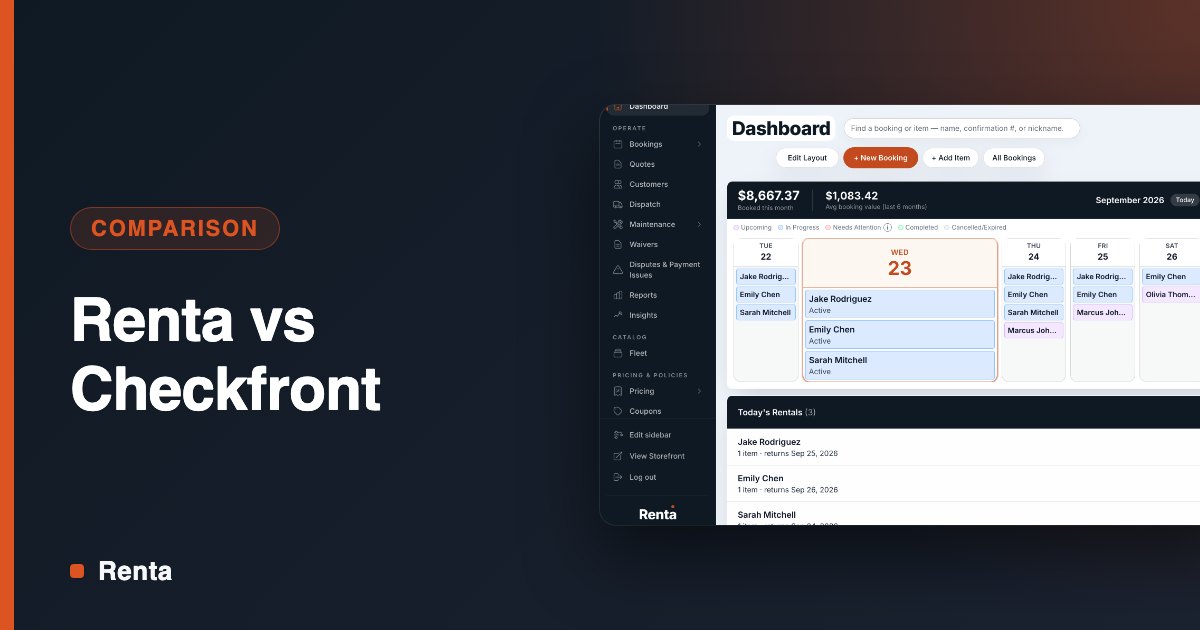
If your rental business mostly needs to sync listings across OTAs like Viator, Expedia, and GetYourGuide, Checkfront's established channel management and straightforward online-booking fee make it a solid, proven pick — especially for tour and activity operators with complex, varied booking types. If you run an equipment, gear, or powersports rental business and want your booking engine, storefront website, maintenance tracking, and marketing analytics running in one connected admin instead of several stitched-together tools, Renta is built specifically for that. The right answer genuinely depends on what kind of rental business you run — here's the full breakdown.
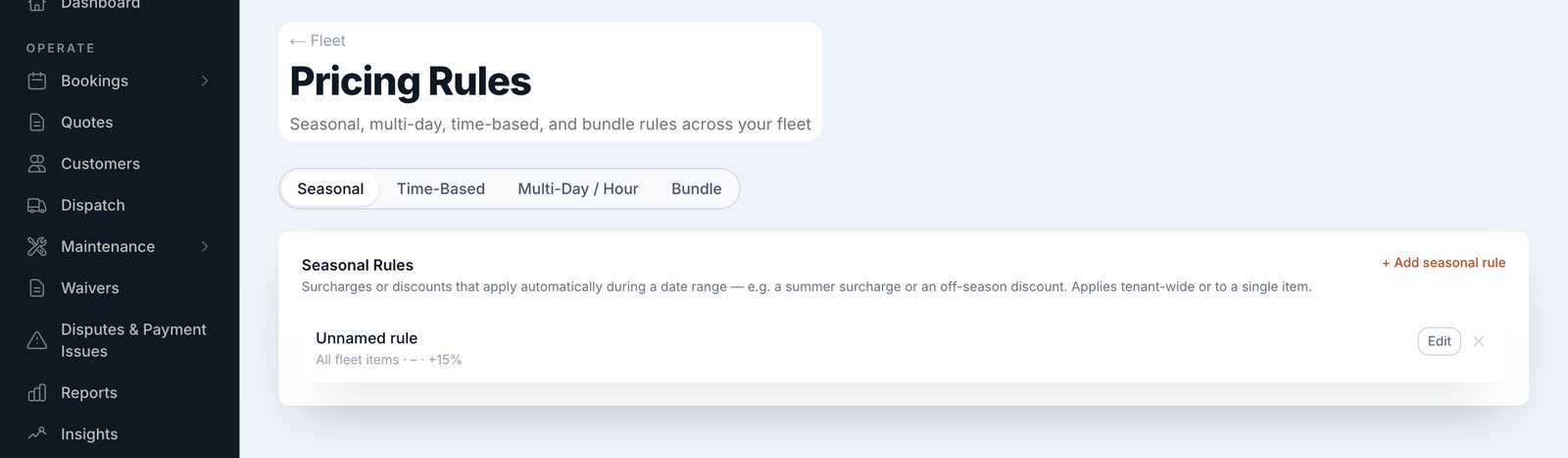
Layered pricing rules: seasonal, time-based, multi-day, and bundle (demo account, sample data).
Quick Answer: Who Should Pick Which
- Pick Checkfront if: you need mature OTA/channel distribution out of the box, your bookings range from hourly rentals to multi-day expeditions with heavily customized pricing rules, and you're comfortable investing setup time to get date and time configuration exactly right.
- Pick Renta if: you run an equipment, gear, or powersports rental operation and want your website, booking system, payments, maintenance schedules, and marketing dashboard in one admin — without needing a separate website platform or a flat SaaS fee before you've taken your first booking.
Renta vs Checkfront: Feature-by-Feature
| Feature | Renta | Checkfront |
|---|---|---|
| Core focus | Equipment, gear & powersports rental storefronts | Tour, activity, and equipment reservation management |
| Booking & availability | Day-rate, hourly with daily caps, half-day slots, fixed packages | Real-time daily/multi-day/timeslot/flextime calendars |
| OTA channel sync (Viator, Expedia, GetYourGuide, Google) | Not a core focus today | Native, established channel management |
| Payments | Stripe Connect with deposit holds and dispute tracking | Built-in payment gateway plus in-person POS |
| Online booking fee | Commission-based; no flat SaaS fee required to start | Percentage-based fee on online bookings (see Checkfront's own pricing page for current rates) |
| Digital waivers | Automated single-signer or per-rider waiver requests | Digital waivers included |
| Pricing rule flexibility | Seasonal, multi-day discount, day-of-week, bundle rules, flexible add-ons | Dynamic pricing and product bundles |
| Marketing & analytics dashboard | Built-in revenue, acquisition-source, repeat-customer, GA4/Search Console, PageSpeed data in the same admin | Not described in Checkfront's public feature set |
| Equipment maintenance tracking | Usage-meter-based schedules (engine hours/mileage) with automatic overdue/due-soon/ok status, plus a maintenance-spend report | Not described in Checkfront's public feature set |
| Website/storefront builder | Full page builder that IS the live storefront where bookings happen | Booking engine designed to embed into an existing site |
| QuickBooks Online sync | Built in | Not confirmed in public materials |
| Multi-location & delivery | Multi-location pickup plus a delivery dispatch board with driver assignment | Resource and inventory management across locations |
Pricing: Renta vs Checkfront
Checkfront prices itself around a base monthly plan plus a percentage-based fee on online bookings, a fee that businesses can typically choose to absorb or pass along to the customer. We're deliberately not quoting exact dollar figures here — SaaS pricing pages change often, and older tiers you may see repeated on third-party comparison sites don't always reflect current numbers. Before you decide, pull up Checkfront's own pricing page for what it charges today, and take advantage of whatever free trial it's currently offering to see the real admin before comparing numbers on a page.
Renta doesn't require a flat monthly SaaS fee to get started at all — pricing is commission-based, so cost scales with what you actually book rather than being due up front. That tends to favor newer, seasonal, or smaller operators who don't want a fixed bill before they've made a rental; high-volume operators should run the math on both models, since a flat-fee plan can work out cheaper once you clear a certain booking volume.
Where Checkfront Is Genuinely Better
Checkfront has been in this market a long time, and it shows in the places that take years to build. Its OTA and channel integrations are genuinely mature — syncing availability and listings with Viator, Expedia, GetYourGuide, and Google Things To Do is a core, well-supported part of the product, not a bolt-on. For tour and activity operators (and equipment renters who also sell adventure-style experiences) who depend on OTA-driven bookings, that's a real, earned advantage. Checkfront also handles genuinely complex, varied booking logic well — hourly rentals, multi-day expeditions, and custom pricing rules living side by side in one calendar system — a real strength for operators who need that range in one place. And its fee structure is straightforward on its face: a percentage charge on online bookings rather than a maze of add-on fees for API access or OTA connections.
To be fair, that maturity comes with some friction. A platform built to handle this much configurable complexity — dates, times, resource rules, channel mappings — tends to come with a real setup learning curve, and operators evaluating it should expect to spend meaningful time getting date and time rules configured exactly right, possibly with help from support along the way. That's the tradeoff for handling booking types Renta doesn't yet support out of the box.
Where Renta Is Genuinely Better
Renta's advantage isn't "more features" in the abstract — it's fewer separate tools for a specific kind of rental business. If you rent equipment, gear, or powersports vehicles, your website, your booking calendar, your payments, and your fleet's maintenance schedule can live in one admin instead of four subscriptions. The built-in marketing dashboard shows revenue by period and category, where customers are coming from, your repeat-customer rate, and your most popular items, alongside native Google Search Console, GA4, and PageSpeed summaries — so you're not logging into a separate analytics tool just to see whether last month's marketing worked. The maintenance tracker ties directly to real usage meters (engine hours or mileage), flags units as overdue, due-soon, or ok automatically, and resets the schedule the moment a service gets logged — something a general-purpose booking platform typically won't do because it isn't built around physical fleet upkeep.
Renta's pricing rules also go deep for rental-specific needs: simple day-rates, hourly-with-daily-caps, half-day slots, and fixed packages, layered with seasonal, multi-day, day-of-week, and bundle pricing, plus flexible add-ons (flat, per-day, percent-of-item, or multi-choice) and coupons with per-customer, per-category, or per-item limits. Automated communications — a unified inbox, automated waiver requests, automated post-rental review requests, and quotes with expiry dates — cut down the manual follow-up that eats a small operator's week. And the website builder isn't a marketing-only site bolted onto a booking widget; operators build and publish real pages, control their own theme and brand, and that same site is the storefront where the booking actually happens.
The financial plumbing is built in too: payments run through Stripe Connect with deposit holds and dispute tracking, gift cards are supported natively, and QuickBooks Online sync keeps the books current without manual exports — pieces operators on other platforms often have to wire together themselves through a payment processor, a separate gift-card app, and an accounting integration bought à la carte.
We'll say plainly where Renta is still catching up: it's a newer platform than incumbents like Checkfront, so it has a smaller install base and fewer third-party integrations and marketplace listings today, and its extension ecosystem is still growing. It's strongest right now for equipment, powersports, and gear rental operators specifically — it's less proven for large, multi-department enterprise fleets, which is closer to where Checkfront's higher, more established tiers are positioned.
See Renta in Action
Here is what the software actually looks like. Screens marked "demo account" come from Renta's demo shop with sample data, so every customer name shown is fictional.
Digital waivers
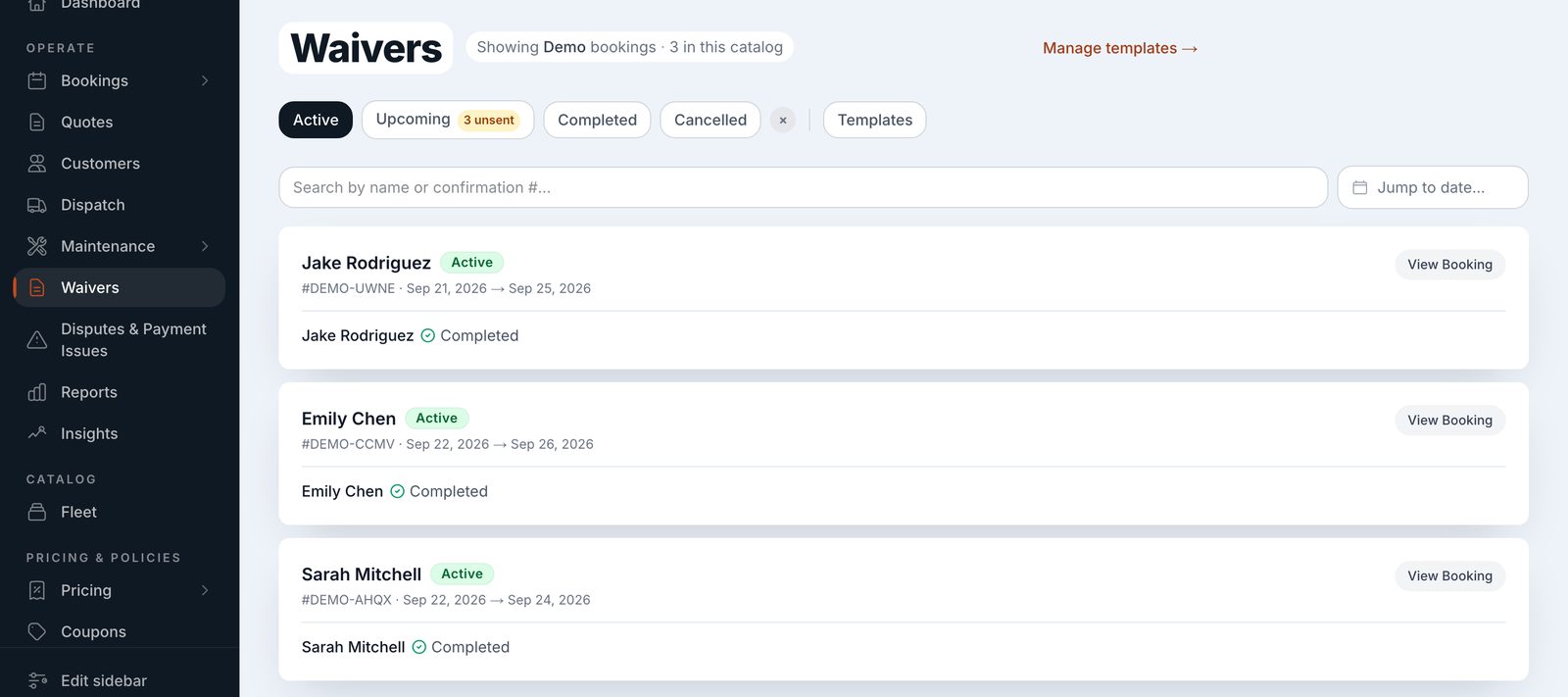
Digital waivers tied to each booking, with completion status at a glance (demo account, sample data).
Maintenance tracker
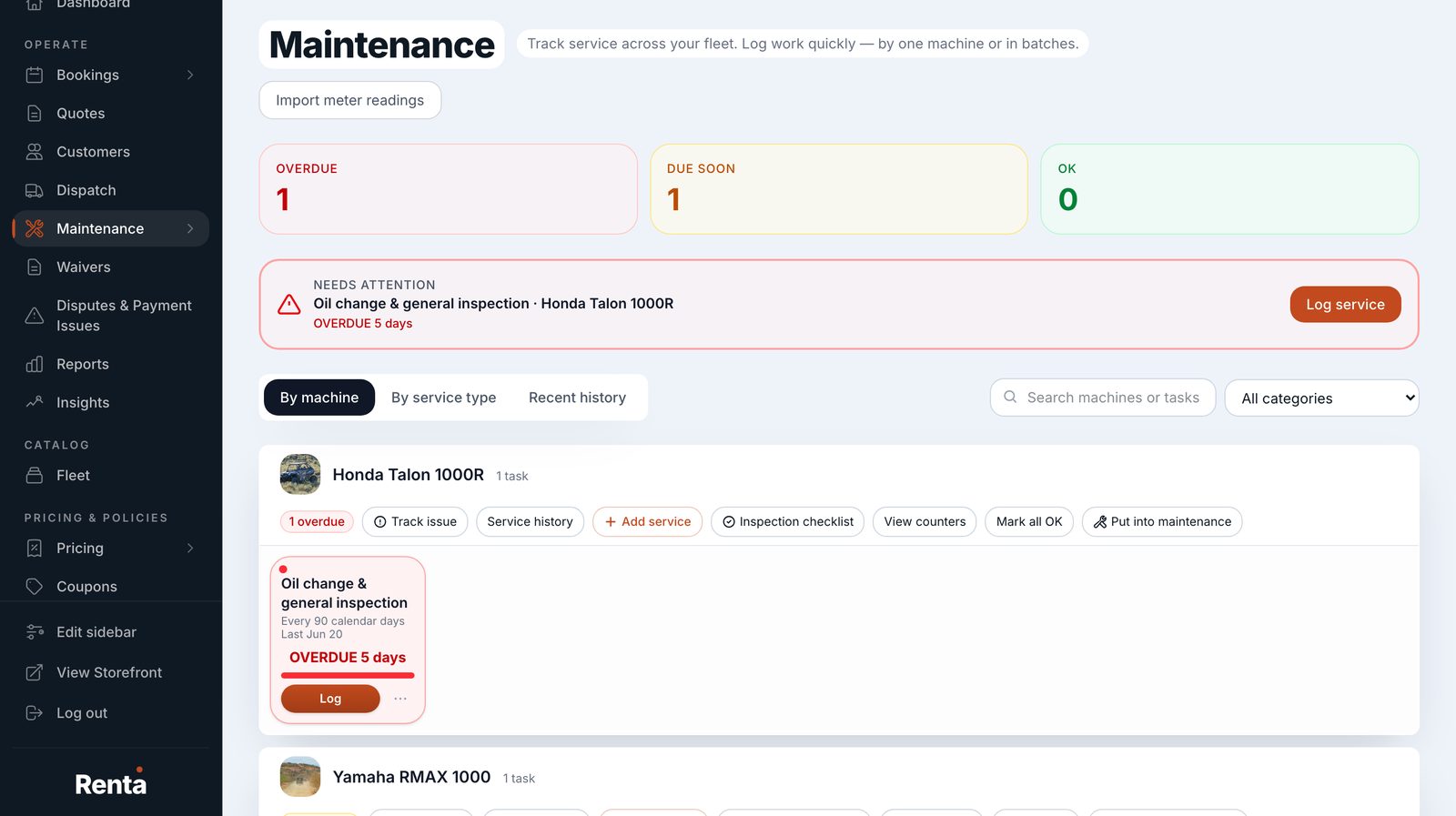
Renta's maintenance tracker flags overdue and due-soon service, machine by machine (demo account, sample data).
Frequently Asked Questions
Is Renta cheaper than Checkfront?
Checkfront runs on a monthly plan plus a percentage fee on online bookings — check its current pricing page for exact numbers, since plans and tiers can change over time. Renta doesn't require a flat monthly fee to start at all; it runs on commission-based pricing, so cost scales with your actual bookings. Which one works out cheaper depends on your volume: high-booking operators may do better on a flat-fee plan once they clear a certain volume, while newer or seasonal businesses often prefer not paying anything before they've made a rental.
Does Checkfront integrate with OTAs like Viator and Expedia?
Yes. Checkfront has established channel management that syncs listings and availability with Viator, Expedia, GetYourGuide, and Google Things To Do. It's widely regarded as one of Checkfront's core strengths, particularly for tour and activity operators who rely on OTA traffic.
Can Renta track equipment maintenance?
Yes. Renta includes a maintenance tracker tied to real usage meters — engine hours or mileage — with automatic overdue, due-soon, and ok statuses, plus a maintenance-spend report. Logging a completed service automatically resets the schedule. Checkfront's public feature set doesn't describe an equivalent built-in maintenance module.
Does Renta come with its own website builder, or do I need a separate site?
Renta includes a full page builder that operators use to build and publish their own site and control the theme and brand — and that same site is the actual storefront where bookings happen, not a separate marketing-only page. That's different from a booking widget meant to be embedded into a website built somewhere else.
Is Checkfront harder to set up than Renta?
Checkfront's flexibility around dates, times, and resource rules is part of what makes it powerful for complex booking types, and that same flexibility means initial setup takes real time and attention to configure correctly. We don't have directly comparable setup-time data for Renta, so if setup speed matters most to you, it's worth trying both platforms' trials before deciding.
Which platform is better for a small equipment rental business just starting out?
Renta was built with equipment, powersports, and gear rental in mind, and its commission-based pricing means no flat monthly fee before you've taken a booking — alongside a marketing dashboard, maintenance tracker, and website builder in the same admin. Checkfront is a strong choice for larger or more established operators who need mature OTA distribution or highly complex multi-day booking rules and are already comfortable with its setup process.