FareHarbor and Renta both run online booking, scheduling, and payments for rental and activity businesses, but they're built for different owners. FareHarbor is a large, well-established platform (acquired by Booking Holdings in 2018) built primarily for tours, activities, and attractions, and it makes its money through a booking fee charged to your customers rather than a subscription. Renta is a newer platform built specifically for equipment, gear, and powersports rental operators, with flexible pricing rules, a real website builder, and fleet-maintenance tools baked into the same admin.
If you run guided tours or activities and want a proven name with deep distribution into Booking.com, Viator, and Expedia, FareHarbor is the safer bet. If you rent physical equipment — ATVs, jet skis, bikes, tools, party gear — and want pricing flexibility plus tools built around keeping a fleet running, Renta is worth a serious look. Neither platform is a universal best choice — the right pick comes down to whether your product is an experience you guide or an asset you hand over and have to maintain.
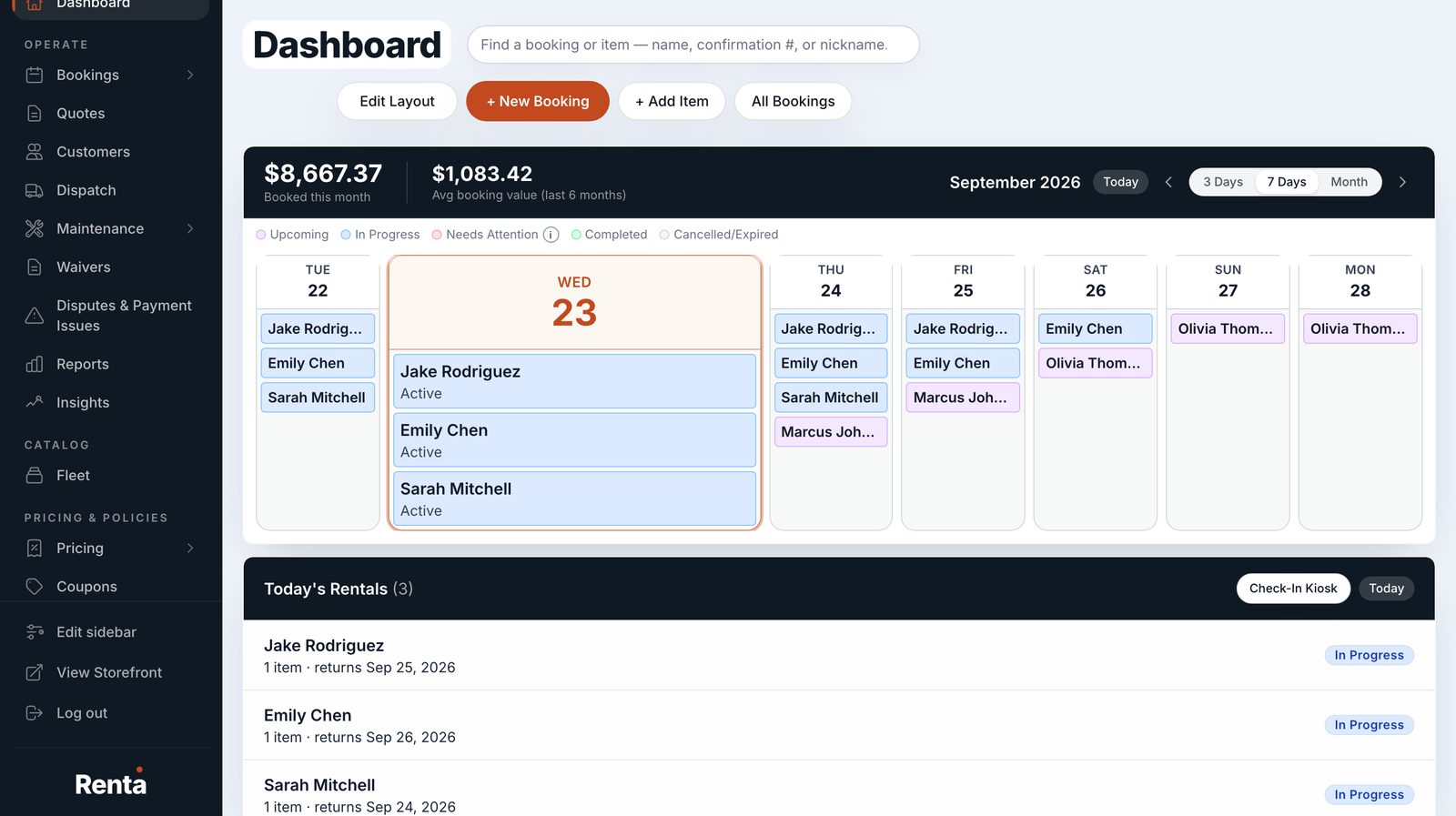
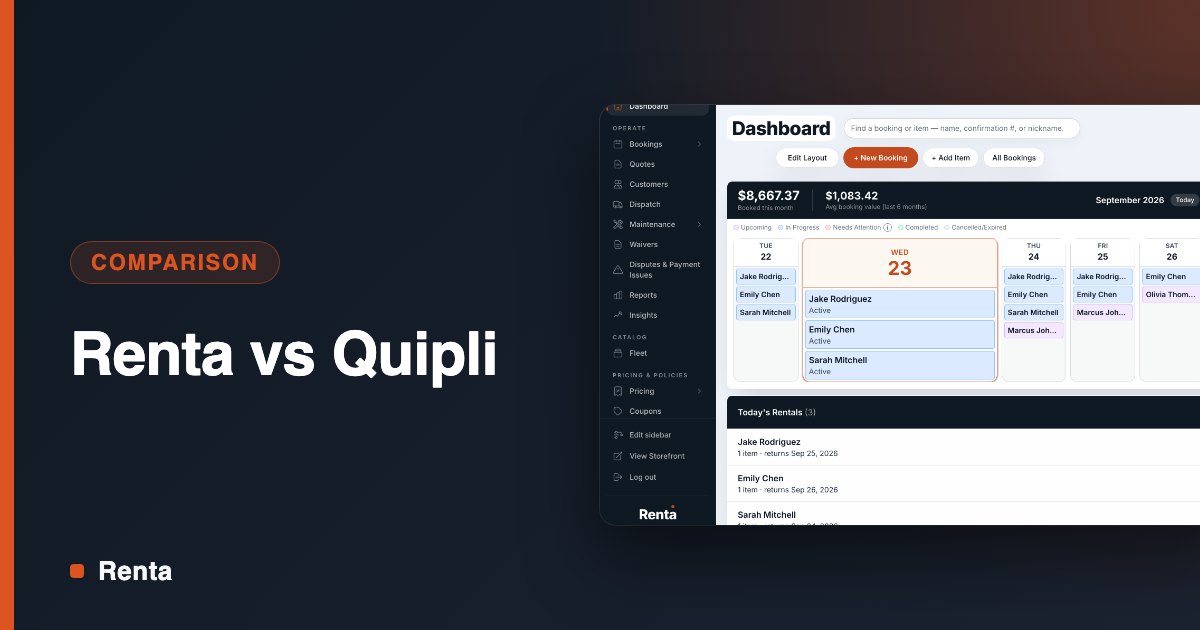
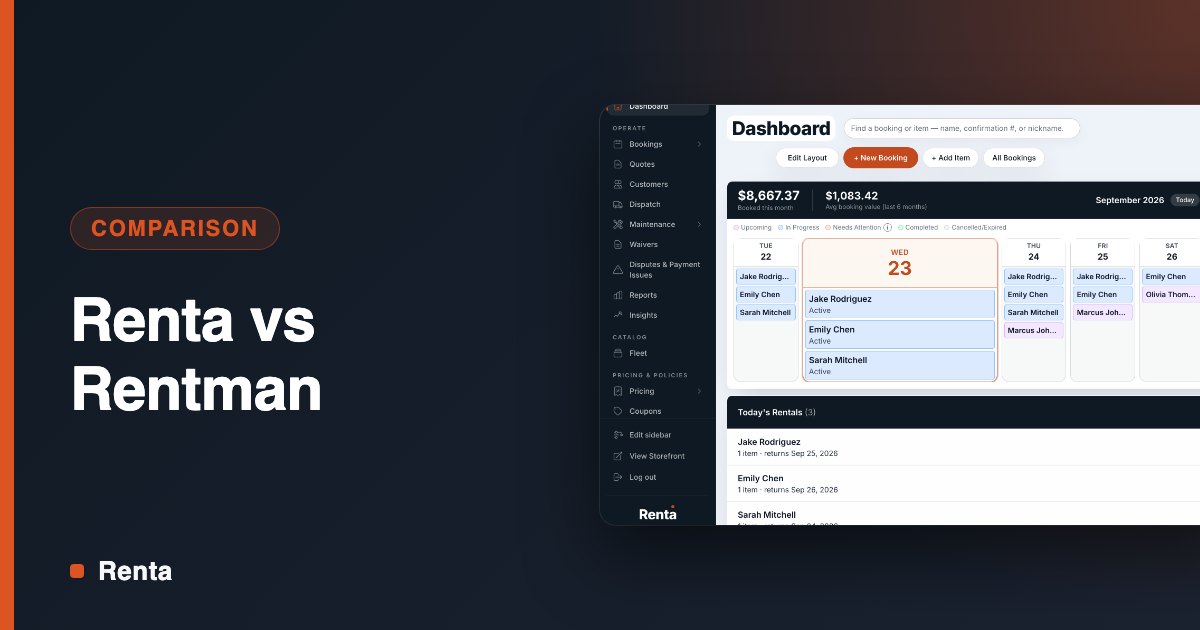
Renta's booking dashboard: a live calendar and today's rentals at a glance (demo account, sample data).
Renta vs FareHarbor at a Glance
| Category | Renta | FareHarbor |
|---|---|---|
| Best for | Equipment, gear, and powersports rental operators | Tour operators, activity providers, attractions |
| Pricing model | Commission-based option available — no flat SaaS fee required to start | No monthly/setup fee; revenue comes from a customer-facing booking fee |
| Fee passed to customer | Operator sets fees/pricing directly (day-rate, hourly, packages, add-ons) | Typically 6-8% booking fee plus ~1.9% + $0.30 processing per ticket |
| Fleet maintenance tracking | Built-in — usage-based schedules tied to engine hours/mileage, auto overdue status | Not a core feature (not built for asset-heavy fleets) |
| Website builder | Full page builder that doubles as the live storefront | Separate website product, reported around $499/month |
| OTA/marketplace distribution | Growing; smaller install base than incumbents | Strong — tied into Booking.com, Viator, TripAdvisor, Expedia |
| Analytics | Built-in dashboard: revenue, acquisition sources, repeat-customer rate, GSC/GA4/PageSpeed summaries in the same admin | Reporting available, but not the same all-in-one marketing view |
| Company maturity | Newer platform, smaller install base | Founded 2013, 24,000+ operators, backed by Booking Holdings |
Pricing: How Each Company Actually Makes Money
FareHarbor charges operators no monthly fee and no setup fee. Instead, it recovers revenue by adding a booking fee — commonly cited in the 6-8% range for bookings through your own website, with lower rates (around 2%) reported for bookings that arrive through OTA/API partners like Booking.com or Viator — onto the customer's total at checkout, stacked on top of standard card processing (roughly 1.9% + $0.30 per ticket). In practice, a $100 tour can show up closer to $106-$108 at checkout, even though nothing appears as a platform fee on your own invoice. FareHarbor's optional full website-builder product is reported at around $499/month. FareHarbor doesn't publish one universal rate card, so exact terms can vary by contract and volume — confirm current numbers directly with their sales team before signing anything.
Renta's model is commission-based, meaning there's no flat SaaS fee required just to get started, and pricing itself is fully in your hands: simple day-rates, hourly with daily caps, half-day slots, or fixed packages, layered with seasonal, multi-day, day-of-week, and bundle discount rules, plus flexible add-ons (flat, per-day, percent-of-item, or multi-choice) and coupons that can be capped per customer, per category, or per item. That flexibility matters most for gear and powersports rentals, where pricing rarely fits a single flat rate.
Where FareHarbor Is Genuinely Better
FareHarbor's biggest real advantage is scale and trust: it's been operating since 2013, is now part of Booking Holdings, and reportedly powers 24,000+ operator businesses. That scale translates into deep, proven distribution — direct integrations into Booking.com, Viator, TripAdvisor, and Expedia — which can genuinely move the needle on bookings for tour and activity operators who rely on discovery traffic they don't own. Reviewers also consistently point to ease of use paired with fast, responsive customer support as a real strength; on Capterra, FareHarbor holds roughly a 4.7-star rating across more than 1,100 verified reviews as of this writing (reviewers also flag occasional technical and communication issues, so weigh recent reviews for yourself before deciding). If your business is tours, excursions, or attraction tickets and you want an established platform with a large support and integration ecosystem already built out, that's a legitimate reason to choose FareHarbor over a newer competitor.
Where Renta Is Genuinely Better
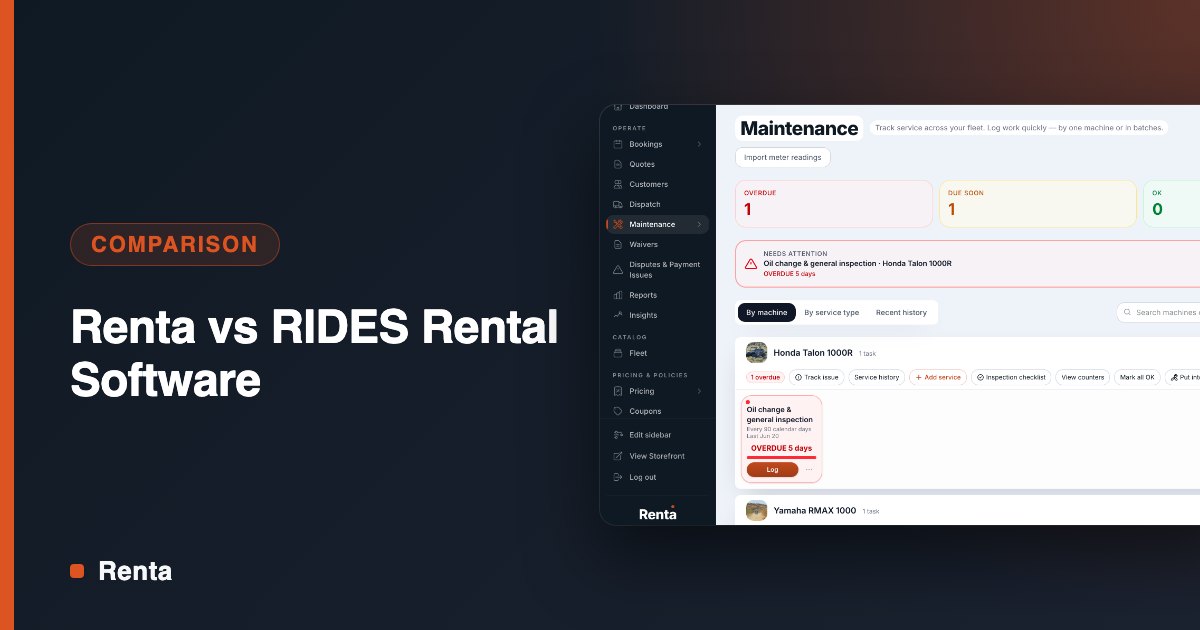
Renta was built with equipment and gear rental operators in mind first, not adapted from a tours-and-activities model, and it shows in a few specific places. The maintenance tracker ties directly to real usage meters — engine hours or mileage — so each unit gets an automatic overdue/due-soon/ok status, a logged service resets the schedule, and you get a maintenance-spend report without exporting anything to a spreadsheet. FareHarbor has no equivalent built for asset-heavy fleets.
Renta's pricing engine is also more flexible out of the box: day-rates, hourly-with-caps, half-day slots, and fixed packages can all run side by side, layered with seasonal, multi-day, day-of-week, and bundle pricing rules, plus add-ons priced flat, per-day, as a percent of the item, or as multi-choice options. The website builder is a real page builder, not a fixed template bolted on — you control the theme and brand tokens, and it's the actual storefront where bookings happen, not a separate marketing microsite. Automated communications (a unified inbox, waiver-signature requests that can require a single signer or one per rider, post-rental review requests, and quotes with expiry dates) cut down on manual follow-up, and the built-in marketing dashboard shows revenue by period/category, acquisition sources, repeat-customer rate, your most-popular items, and native Google Search Console/GA4/PageSpeed summaries — all inside the same admin, no separate analytics login needed. Multi-location pickup, a delivery dispatch board with driver assignment, Stripe Connect payments with deposit holds and dispute tracking, gift cards, and QuickBooks Online sync round out the platform, and none of it requires a flat SaaS fee to get started.
To be honest about where Renta isn't there yet: it's a newer platform than FareHarbor, so it has a smaller install base and fewer third-party integrations and marketplace listings than a company that's been operating since 2013. Its ecosystem of extensions is still growing, and while it's strongest for equipment, powersports, and gear rental operators, it's less proven so far for large, multi-department enterprise fleets. If deep OTA distribution or a long integration marketplace is your top priority today, that's a real gap worth weighing.
Which Platform Fits Your Business
The honest answer depends less on which platform is the "better" company and more on what you actually rent and how you sell it. If your business is guided tours, excursions, classes, or attraction tickets — where the product is an experience delivered by a guide rather than a physical asset that needs upkeep — FareHarbor's scale, OTA integrations, and track record make it the lower-risk default, especially if a meaningful share of your bookings already comes through Booking.com, Viator, or Expedia.
If your business rents physical equipment — ATVs, jet skis, boats, bikes, tools, party and event gear — where pricing needs to flex by day, hour, season, or bundle, and every unit needs its own maintenance history, Renta's fleet-first design is the closer fit. The trade-off is real: Renta is newer, so its OTA reach and third-party integration marketplace are smaller than FareHarbor's today. For an equipment-heavy operator willing to trade some of that distribution for pricing flexibility, built-in maintenance tracking, and a website builder that doubles as the storefront, that trade-off tends to be worth it.
See Renta in Action
Here is what the software actually looks like. Screens marked "demo account" come from Renta's demo shop with sample data, so every customer name shown is fictional.
Reviews and outreach
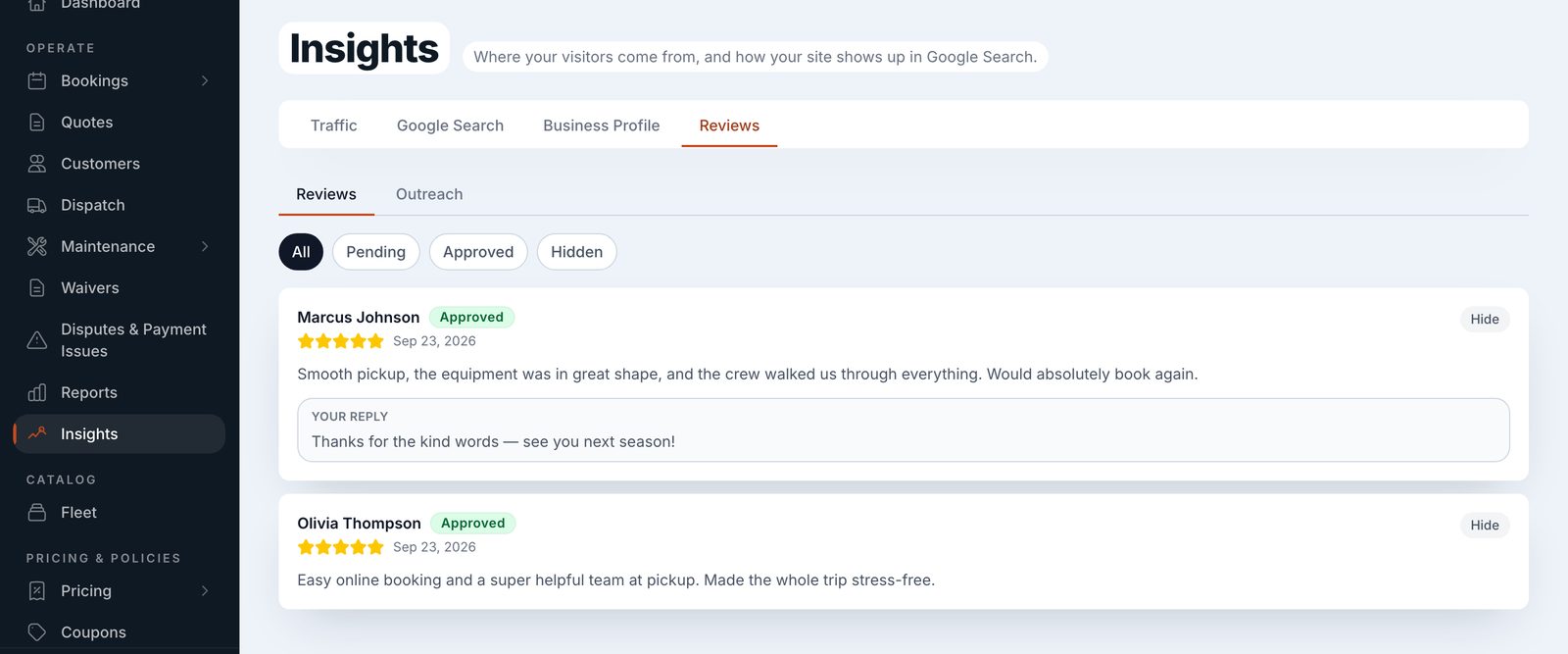
Review management and outreach, so happy riders turn into public reviews (demo account, sample data).
A site built with Renta's website builder
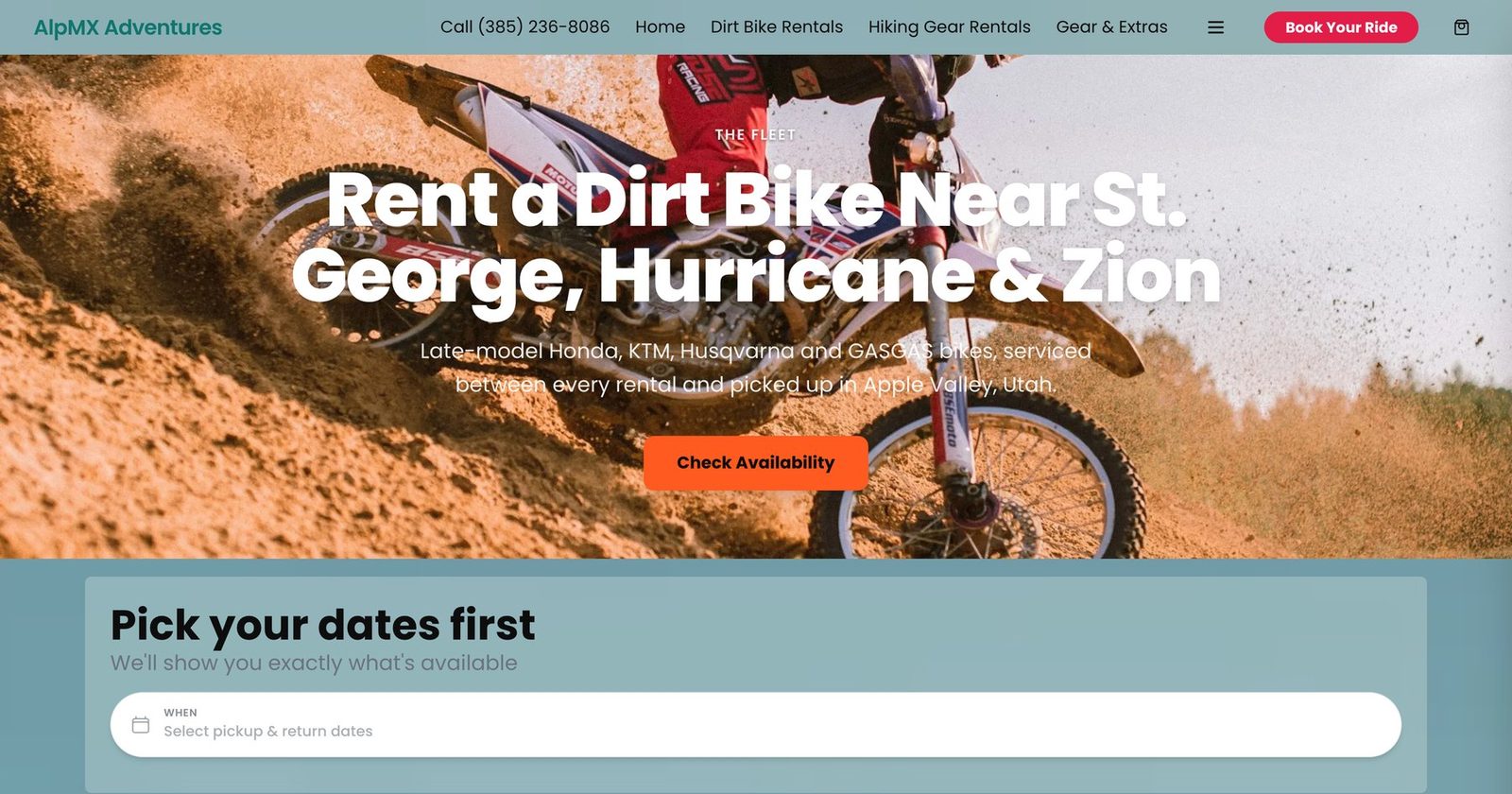
alpmxadventures.com, a live rental business site built with Renta's website builder.
Frequently Asked Questions
Is Renta cheaper than FareHarbor?
It depends on your volume and pricing structure. FareHarbor charges no monthly fee but adds a customer-facing booking fee (commonly cited around 6-8%) plus standard card processing on every transaction. Renta offers a commission-based option with no flat SaaS fee required to start, and pricing itself stays fully under your control — day-rates, packages, and add-ons are whatever you set them at. Exact costs for either platform depend on your contract terms, so compare actual numbers for your booking volume before deciding.
Does FareHarbor charge a monthly fee?
No. FareHarbor doesn't charge operators a monthly subscription or setup fee for its core booking product. It instead recovers revenue through a booking fee added to the customer's total at checkout, typically in the 6-8% range, plus standard payment processing of roughly 1.9% + $0.30 per ticket. Its separate full website-builder product is reported at around $499/month.
Which is better for equipment or gear rental businesses, Renta or FareHarbor?
Renta is built specifically for equipment, gear, and powersports rental operators, with usage-based maintenance tracking and flexible day/hour/package pricing. FareHarbor is built primarily for tours, activities, and attractions, and doesn't include fleet-maintenance features. Renta also adds multi-location pickup and a delivery dispatch board with driver assignment, which matter for operators juggling more than one yard or offering drop-off. If your inventory is physical equipment that needs upkeep tracking, Renta is the closer fit.
Does Renta have a website builder like FareHarbor?
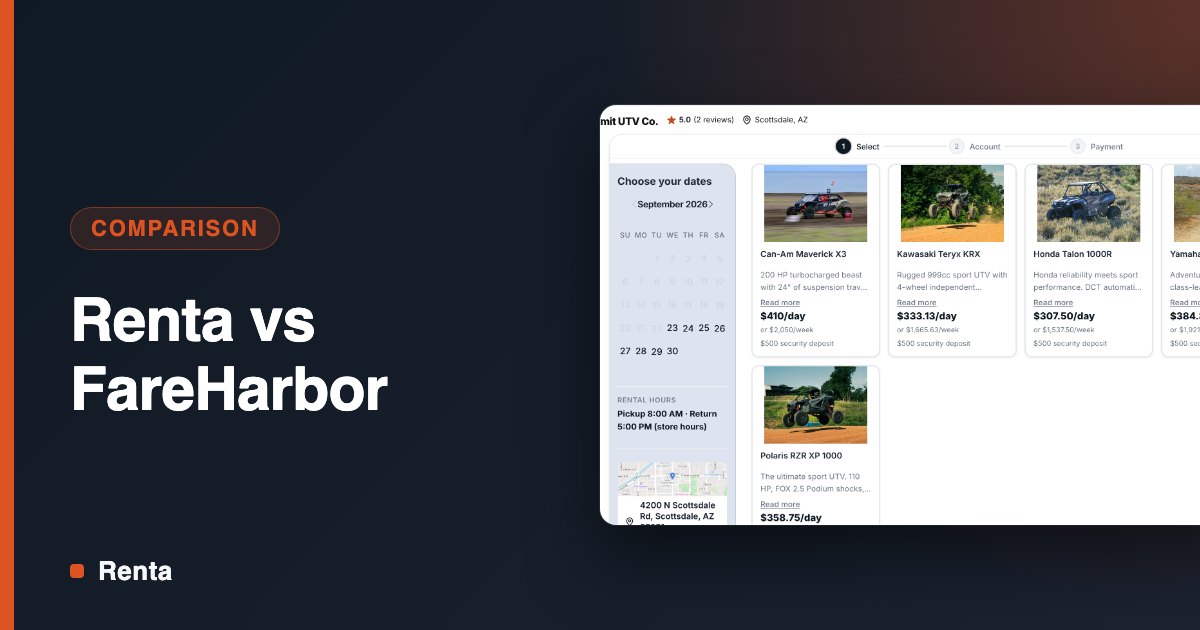
Yes. Renta includes a full page builder that operators use to build and publish their own pages and control the theme and brand tokens, and it also serves as the live storefront where bookings actually happen. FareHarbor offers a separate website-builder product, reported at roughly $499/month, apart from its core booking fees.
Does FareHarbor integrate with Booking.com and Viator?
Yes. FareHarbor is owned by Booking Holdings and has built-in distribution integrations with major OTAs including Booking.com, Viator, TripAdvisor, and Expedia. This is one of its most cited real strengths, since operators can gain visibility on those platforms without building the integrations themselves.
Is Renta a newer company than FareHarbor?
Yes. FareHarbor was founded in 2013 and has grown into one of the larger platforms in the space, now part of Booking Holdings. Renta is a newer platform, so it has a smaller install base and fewer third-party integrations so far, though its feature set — especially for equipment and gear rental — is built and shippable today.