If you run an independent equipment or tool rental yard, Quipli was built specifically for you: a flat-fee, all-in-one platform aimed at construction and tool rental businesses. Renta serves a wider range of rental operators — equipment, powersports, adventure gear, and more — with a real website builder, commission-based pricing that doesn't require a flat fee to start, and marketing analytics built into the same admin. Pick Quipli if you want one predictable annual price and you're happy embedding a storefront into a site you already have. Pick Renta if you want your website, pricing, and marketing to scale with your revenue instead of being billed the same amount whether business is slow or booming.
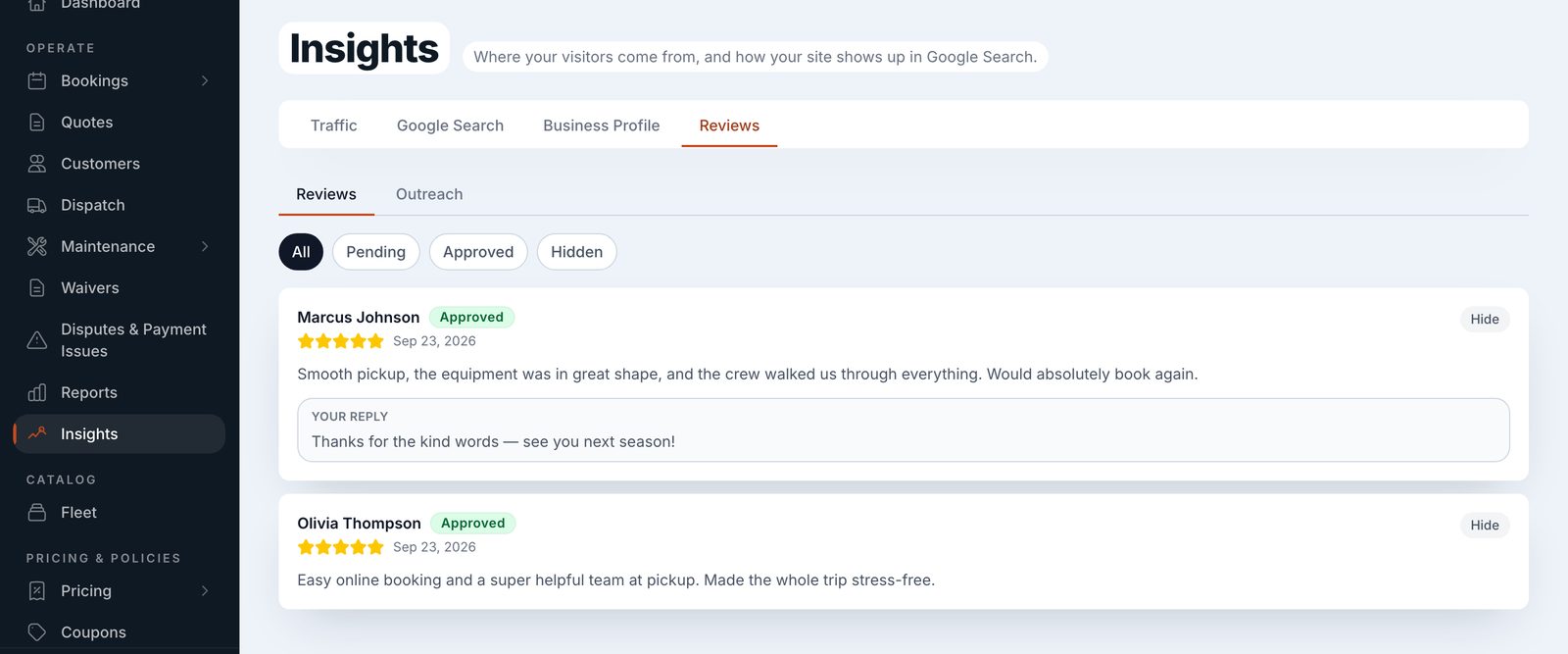
Review management and outreach, so happy riders turn into public reviews (demo account, sample data).
Renta vs Quipli at a Glance
Both platforms handle the basics of online rental booking — availability, payments, waivers. Where they diverge is in scope: Quipli is a focused tool for independent equipment yards, while Renta is a broader platform that also wants to be your website, your marketing dashboard, and your maintenance log. If you're not yet sure which category your business falls into, the table below is the fastest way to check row by row — then read the sections after it for the reasoning behind each one, including where each platform genuinely wins.
| Feature | Renta | Quipli |
|---|---|---|
| Best fit | Equipment, powersports, and outdoor gear rental businesses of any size | Independent, single- or multi-location construction and tool rental yards |
| Website / storefront | Full page builder — you build, brand, and publish your own site; the storefront is the site | A storefront widget that embeds into a website you already have |
| Pricing engine | Day-rate, hourly-with-daily-cap, half-day, and fixed-package pricing, plus seasonal, multi-day, day-of-week, and bundle rules | Standard online booking and checkout for rental orders |
| Add-ons & coupons | Flat, per-day, percent-of-item, and multi-choice add-ons; coupons with per-customer, per-category, or per-item limits | Not part of Quipli's published feature set |
| Fleet & maintenance | Per-unit schedules tied to real engine hours or mileage, automatic overdue/due-soon alerts, and a maintenance-spend report | Maintenance tracking is included; scheduling depth isn't detailed in public materials |
| Delivery & pickup | Multi-location pickup plus a dispatch board with driver assignment | Delivery coordination |
| Payments & deposits | Stripe Connect with deposit holds, dispute tracking, and gift cards | Integrated digital payments |
| Customer communications | Unified inbox, automated waiver requests (single-signer or per-rider), automated post-rental review requests, quotes with expiry | Digital payments and damage waiver tools; automation depth isn't detailed in public materials |
| Marketing & reporting | Built-in dashboard — revenue by period/category, acquisition sources, repeat-customer rate, native Google Search Console + GA4 summaries, PageSpeed scores | Not part of Quipli's published feature set |
| Accounting | QuickBooks Online sync | Not mentioned in Quipli's published materials |
How Pricing Compares
Quipli prices itself simply: a flat annual fee per rental location, the same whether that location books two rentals a year or two thousand. Support and onboarding are bundled into that fee rather than sold separately, so there's no line-item surprise after signup. The trade-off is that the bill doesn't flex down in a slow season the way a usage-based fee would — a new or seasonal operator pays the same amount in a quiet January as in a busy July.
Renta works differently: it can run on commission-based pricing, so you're not required to pay a flat SaaS fee just to get started. Instead of committing a fixed dollar amount up front, your software cost moves with what you actually book. That's a meaningfully different bet for a seasonal or newer operator — cash goes out when revenue comes in, rather than the other way around. Renta's exact published plan tiers aren't the focus of this comparison; check Renta's pricing page or talk to the team for numbers specific to your fleet size and booking volume, since — like most SaaS pricing — it can vary by plan. As a rough way to frame the decision: if you can predict your rental volume within a fairly narrow range year over year, a flat fee like Quipli's is easier to budget against; if your volume swings a lot by season or you're still ramping up a new location, a model that scales with revenue removes some of that guesswork.
Where Quipli Is Genuinely Better
Quipli's advantage is focus. It was built specifically for independent construction and tool rental yards rather than adapted from a broader platform, and that shows in how narrow and predictable the product is: one flat annual price with support and onboarding folded in, and a storefront widget you drop into a website you already have instead of a whole new site to design and maintain. For an owner who already likes their website, doesn't want to learn a page builder, and wants one predictable bill regardless of season, that's a genuine, structural reason to pick Quipli over a broader platform like Renta.
Quipli isn't the right fit for every rental business, though. Its own marketing and public materials are built around single- and multi-location tool and equipment yards rather than powersports, adventure gear, or a fleet that wants a real page builder and layered pricing rules. And because a flat annual fee is a real commitment, it's worth walking through Quipli's own demo of onboarding, the day-to-day dashboard, and support responsiveness for your specific volume and location count before signing — those operational details aren't something a comparison article can verify on your behalf.
Where Renta Is Genuinely Better
Renta's website builder is a real page builder, not a fixed template — you control the theme and brand tokens, and the site you build doubles as your storefront and booking engine rather than a separate marketing-only page bolted onto a widget. If you don't already have a website you're happy with, or you want a single system instead of a site-plus-embedded-widget, that's a structural difference, not a marketing claim.
Pricing flexibility goes further too: layered rules for seasonal pricing, multi-day discounts, day-of-week pricing, and bundles, on top of day, hourly, half-day, or package rate structures, plus configurable add-ons and coupons with real limits. Maintenance tracking is tied to actual usage — engine hours or mileage — rather than the calendar, so a unit that's been rented hard gets flagged before one that's been sitting idle, even if both were bought the same week. Payments carry more built-in coverage too: Stripe Connect handles deposit holds and dispute tracking in the same admin, gift cards can be sold and redeemed at checkout, and a multi-location business gets pickup workflows alongside the delivery dispatch board — details that start to matter once an operation has more than one lot or storefront. The marketing dashboard bundles revenue, acquisition, and repeat-customer reporting with native Google Search Console, GA4, and PageSpeed summaries, so there's no separate analytics login for the basics. And automated communications — a unified inbox, waiver requests, post-rental review requests, quotes with expiry — cut down on the manual follow-up that eats an operator's evenings.
The honest limitation: Renta is newer than an established, narrower player like Quipli, so it has a smaller install base and fewer third-party integrations or marketplace listings than incumbents in this space — its ecosystem of extensions is still growing. It's strongest today for equipment, powersports, and outdoor gear rental operators specifically; it's less proven for a large, multi-department enterprise fleet. If that's closer to your situation, weigh that against the broader feature set above before deciding.
See Renta in Action
Here is what the software actually looks like. Screens marked "demo account" come from Renta's demo shop with sample data, so every customer name shown is fictional.
Maintenance tracker
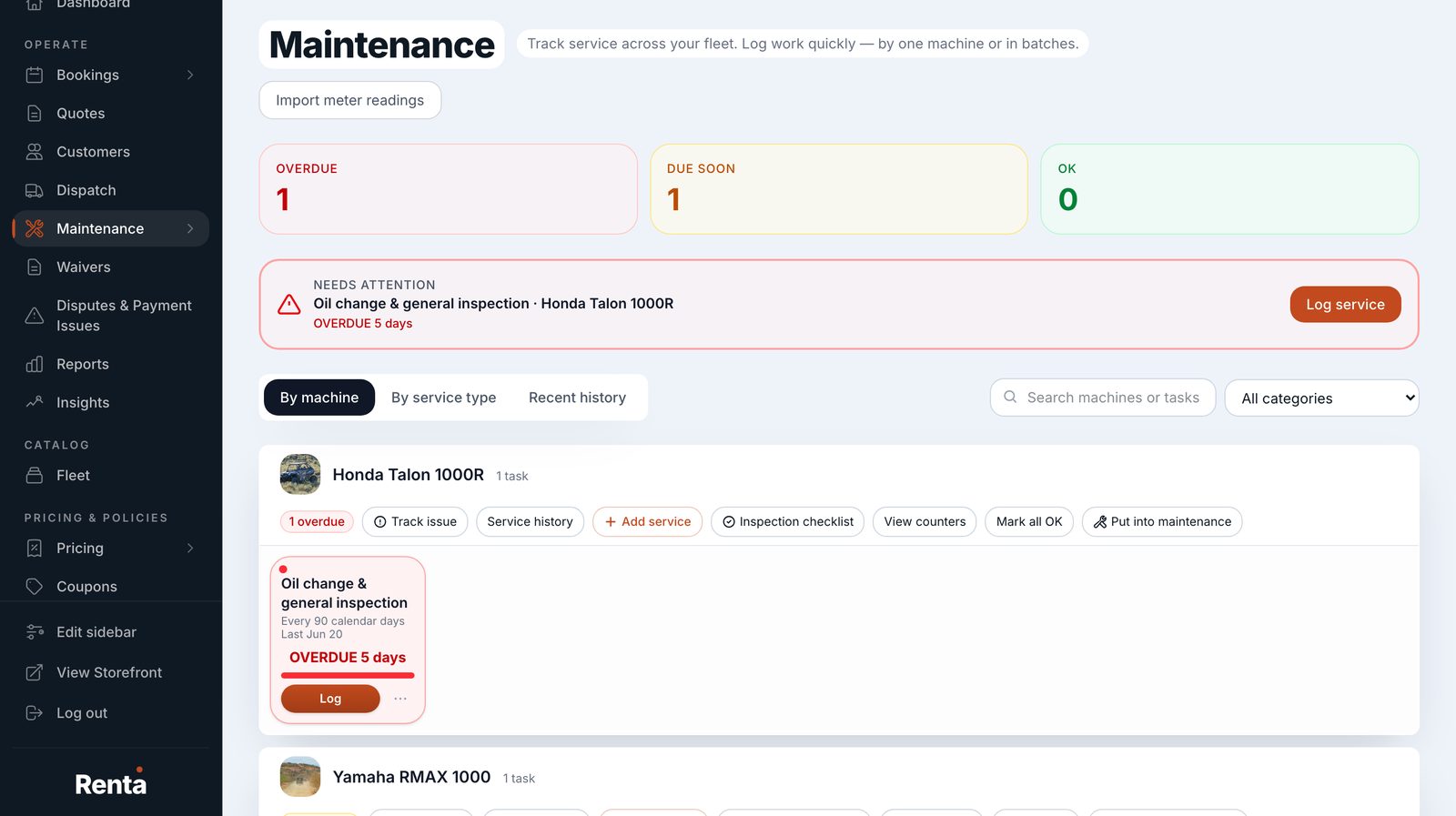
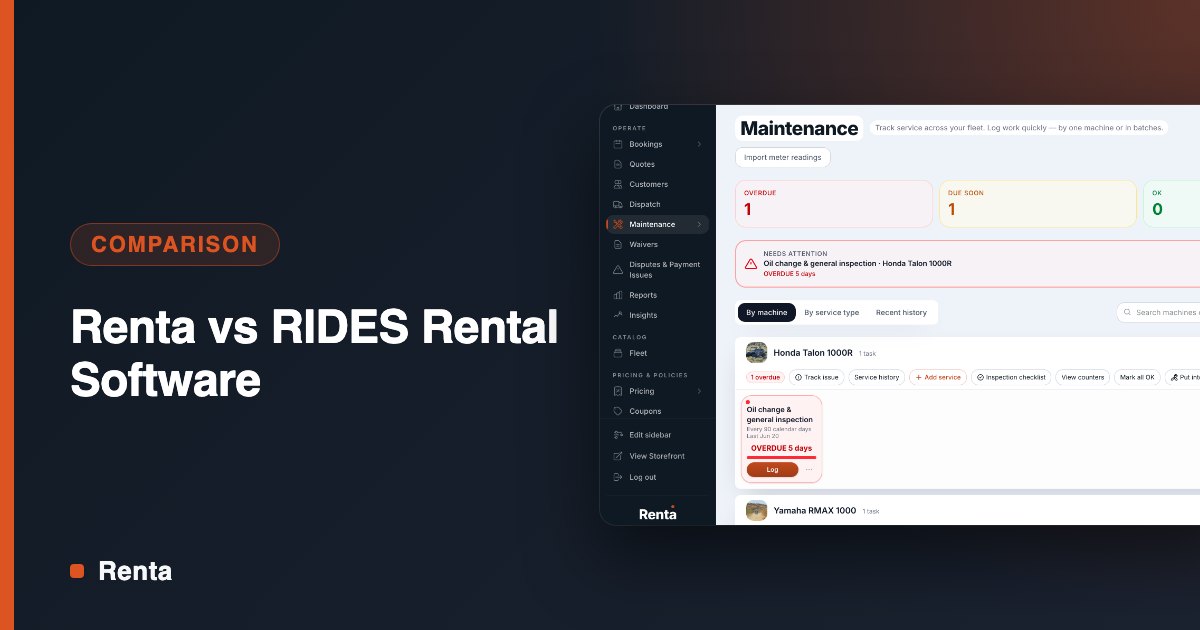
Renta's maintenance tracker flags overdue and due-soon service, machine by machine (demo account, sample data).
Customer records
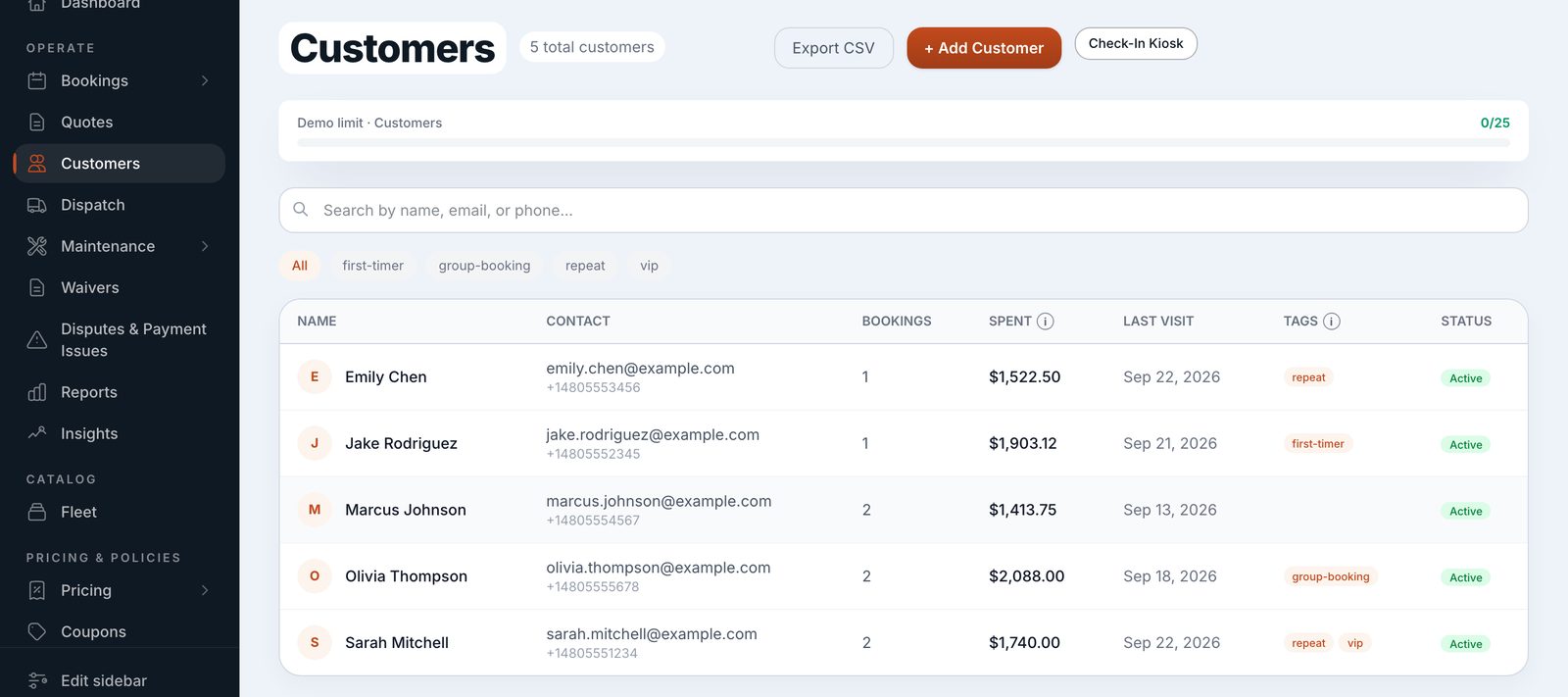
Customer records with booking history, lifetime spend, and tags (demo account; all names and contact details are fictional).
Frequently Asked Questions
Is Quipli cheaper than Renta?
It depends on your volume. Quipli charges a flat annual fee per location, the same whether you book two rentals a year or two thousand. Renta can run on commission-based pricing instead, so a smaller or seasonal operator may pay less overall, while a very high-volume single location could work out differently. Compare your expected annual rental revenue against both models, and get exact numbers directly from each company, before deciding.
Does Renta charge a flat monthly fee like Quipli?
Not necessarily. Renta offers commission-based pricing, so you don't need to pay a flat SaaS fee just to get started. That's different from Quipli's flat annual, per-location price, which applies whether you book one rental or a thousand.
Can I use my own existing website with Quipli, or do I need Renta's builder?
Quipli is built to embed as a storefront widget inside a website you already have. Renta's website builder is a full page builder rather than a widget — it's meant to be the site itself, so the difference shows up most if you don't have a website yet or want to redesign the one you have.
Which is better for a small tool or construction rental business, Renta or Quipli?
Quipli was built specifically for independent construction and tool rental yards, and its narrow focus makes it simple to learn if that's exactly your business. Renta can serve that use case too, but is built more broadly for equipment, powersports, and gear rental — if your business is a straightforward single-location tool yard that just needs simple booking, Quipli's narrower focus may fit; if you also want a website builder, layered pricing rules, and marketing analytics, Renta's broader platform pulls ahead.
Does Renta have maintenance tracking like Quipli?
Yes. Renta tracks maintenance per unit against real usage meters — engine hours or mileage — rather than just a calendar, automatically flags units as overdue, due-soon, or ok, resets the schedule when service is logged, and reports maintenance spend. Quipli includes maintenance tracking as well, though its scheduling depth isn't detailed in public materials.
Is Quipli good for rental businesses outside construction, like powersports or event rental?
Quipli's own marketing and reviews focus specifically on independent equipment and tool rental operators, primarily in construction. If you run a powersports, adventure gear, or event rental business, Renta is built to serve that range directly, alongside equipment rental, rather than being adapted from a construction-focused tool.
Both platforms can run a rental business well — the honest answer is that they're built for different operators. If you want a website you own, pricing that flexes with your revenue, and marketing analytics in the same place you manage bookings, Renta is worth a closer look.