Quick answer: Renta and Rentman solve different problems that happen to both be called "rental software." Rentman is built for AV, event, and production companies that need to schedule crew, gear, and trucks together for one-off jobs. Renta is built for rental businesses — equipment, powersports, gear — that need an online storefront where customers book and pay directly, plus the day-to-day tools (pricing, maintenance, marketing, payments) to run that business. If your bottleneck is "which freelancer and which van goes to which gig," Rentman is the more mature fit. If your bottleneck is "customers can't book or pay online without calling us," Renta is built for exactly that.
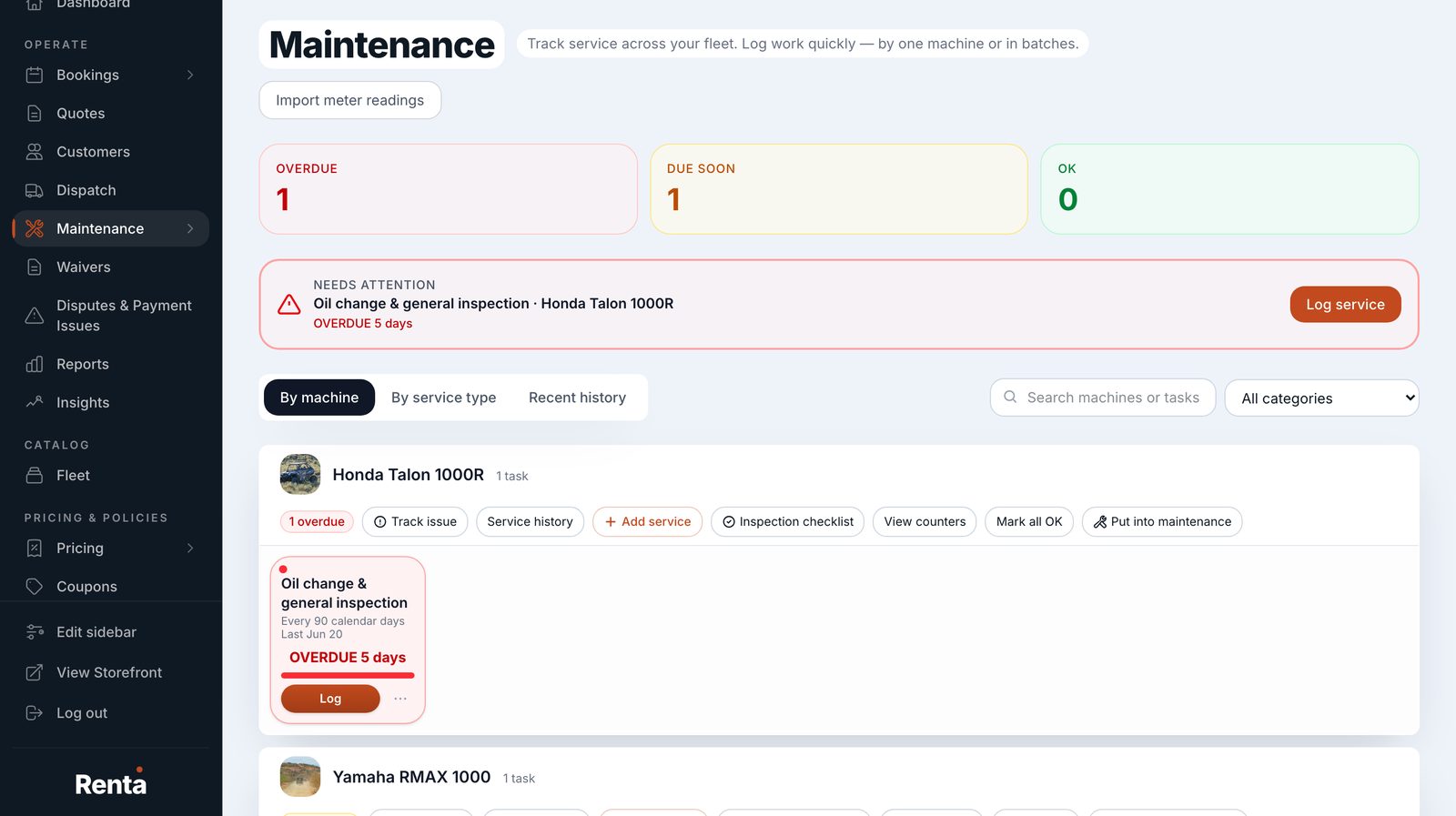
Renta's maintenance tracker flags overdue and due-soon service, machine by machine (demo account, sample data).
Renta vs Rentman: The Short Version
Rentman is a well-established, purpose-built platform for AV, event, and production companies. Its three core modules — Rental Business Management, Inventory Management, and Crew Management — are built around quoting a production job, tracking the gear for it, and scheduling the freelance crew and vehicles needed to deliver it. That focus has made it a genuinely established name in that specific corner of the rental world, where coordinating people, equipment, and transport for one-off gigs is the whole job, not a side feature.
Renta comes at the problem from a different angle. It's built for rental operators — think powersports, outdoor gear, general equipment — who need customers to find them online, check availability, book, sign a waiver, and pay, all without a phone call. Renta bundles the storefront (a real website builder, not a template), the booking engine, payments, and the operational stuff that keeps a rental fleet running (maintenance schedules, pricing rules, a marketing dashboard) into one system.
Neither one is "better" in the abstract. They're built for different jobs, and the honest comparison is about which job matches yours.
Feature-by-Feature Comparison
| Feature | Renta | Rentman |
|---|---|---|
| Core focus | Online booking storefront + operations for equipment, powersports, and gear rental businesses | Project, crew, and transport management for AV, event, and production companies |
| Customer-facing booking site | Built-in website builder that doubles as your live storefront — you build and publish it, customers book on it | Built around quoting and invoicing a job, not a public online checkout |
| Payments & deposits | Stripe Connect with deposit holds, dispute tracking, and gift cards, built in | Not part of Rentman's published feature set |
| Equipment inventory | Per-item availability, categories, tags, multi-location pickup | Dedicated inventory module with multi-location tracking, built around gear the business already owns rather than a public catalog |
| Crew & transport scheduling | Not a dedicated module today | Standout feature — schedules freelance crew and matches jobs to vehicles alongside equipment, in one planner |
| Maintenance tracking | Per-unit schedules tied to real usage (engine hours or mileage), automatic overdue/due-soon status, spend reporting | Not part of Rentman's published feature set |
| Marketing & analytics | Built-in dashboard: revenue by period/category, acquisition sources, repeat-customer rate, plus native GA4/Search Console and PageSpeed data | Not part of Rentman's published feature set |
| Automated customer communication | Unified inbox, automated waiver requests, automated post-rental review requests, quotes with expiry | Quoting and invoicing workflow built in; broader automation isn't documented |
| Pricing flexibility | Day, hourly-with-caps, half-day, or package rates; seasonal, multi-day, and bundle pricing rules; add-ons; coupons | Project-based quoting suited to AV/event jobs |
| Accounting sync | Native QuickBooks Online sync | Not part of Rentman's published feature set |
| Ecosystem & integrations | Smaller and still growing — fewer third-party integrations than established players | Longer-established platform with a broader base of existing integrations built up over time in the AV/production space |
Pricing: How the Two Actually Charge
Rentman doesn't publish one flat number. It runs on tiered subscription pricing that scales with how many inventory items you track, which add-ons you turn on, and how many "power user" seats you need. There's a free trial, and larger accounts appear to move to custom quotes. Because pricing is usage-based, two shops on paper-identical plans can end up paying very different amounts, so treat any number you see elsewhere as a starting point, not a guarantee — get a current quote directly from Rentman if the exact figure matters to your decision.
Renta runs on commission-based pricing, meaning there's no flat SaaS fee required just to get your storefront live — you're not paying a subscription before you've booked a single rental. That model tends to favor newer or seasonal operators who don't want a fixed monthly cost sitting on the books during a slow month, while Rentman's tiered-subscription model tends to favor established shops with predictable, high-volume bookings where a flat fee amortizes easily.
Where Rentman Is Genuinely Better
If your business is AV, event production, or anything where a single job means coordinating gear, freelance crew, and a truck at the same time, Rentman's combined planner is the real strength here — a genuinely mature, purpose-built tool for exactly that workflow, refined over years of serving that specific niche. That focus is Rentman's whole value proposition: crew-and-transport scheduling is native to the product instead of bolted on, which is why production companies choosing between spreadsheets, generic project software, and Rentman tend to land on Rentman.
It's fair to also note where that same focus creates gaps, because no platform is without trade-offs: Rentman isn't built as a consumer-facing booking storefront, its published feature set doesn't include online payments or deposit holds, and its workflow assumes staff are creating a quote for a job rather than a customer booking and paying directly. If your business runs on production jobs rather than direct-to-consumer bookings, none of that is really a drawback. If it's the opposite — if your customers expect to book and pay online themselves — it's worth knowing going in that Rentman wasn't built to do that part.
Where Renta Is Genuinely Better
If you're renting equipment, powersports, or gear directly to consumers and your actual bottleneck is "people can't book and pay online without a phone call," that's the problem Renta was built to solve. The website builder is a real page builder, not a fixed template — you control the brand, the theme, and the layout, and it doubles as the live storefront where bookings happen, not a separate marketing site bolted onto a back-office tool.
Beyond the storefront, the operational pieces stack up for a gear-rental business specifically: a maintenance tracker tied to actual usage meters (engine hours or mileage) that flags overdue service automatically, resets the schedule once service is logged, and shows what maintenance is costing you; pricing that can run as day-rates, hourly with daily caps, half-day slots, or fixed packages with layered seasonal and bundle discounts; and a delivery dispatch board for multi-location pickup and driver assignment. Payments run through Stripe Connect with deposit holds and dispute tracking built in, gift cards are native, and QuickBooks Online sync means your books don't need a manual reconciliation step. The marketing dashboard folds in GA4 and Search Console data so you're not logging into a separate analytics tool just to see where bookings are coming from.
The honest limitation: Renta is a newer platform than incumbents in this space, which means a smaller install base and fewer third-party integrations or marketplace listings today, and that ecosystem of extensions is still growing. Renta is strongest for equipment, powersports, and gear rental operators specifically — it's less proven for large, multi-department enterprise fleets, which is closer to the territory where a platform with Rentman's longer track record matters more.
See Renta in Action
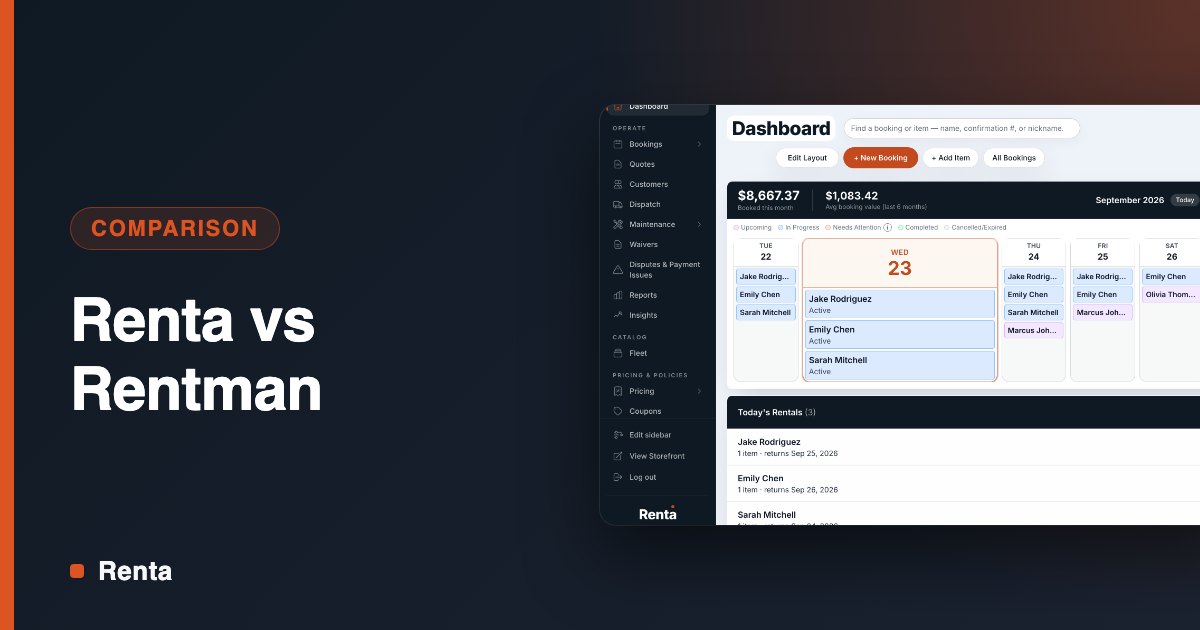
Here is what the software actually looks like. Screens marked "demo account" come from Renta's demo shop with sample data, so every customer name shown is fictional.
Reports and business health
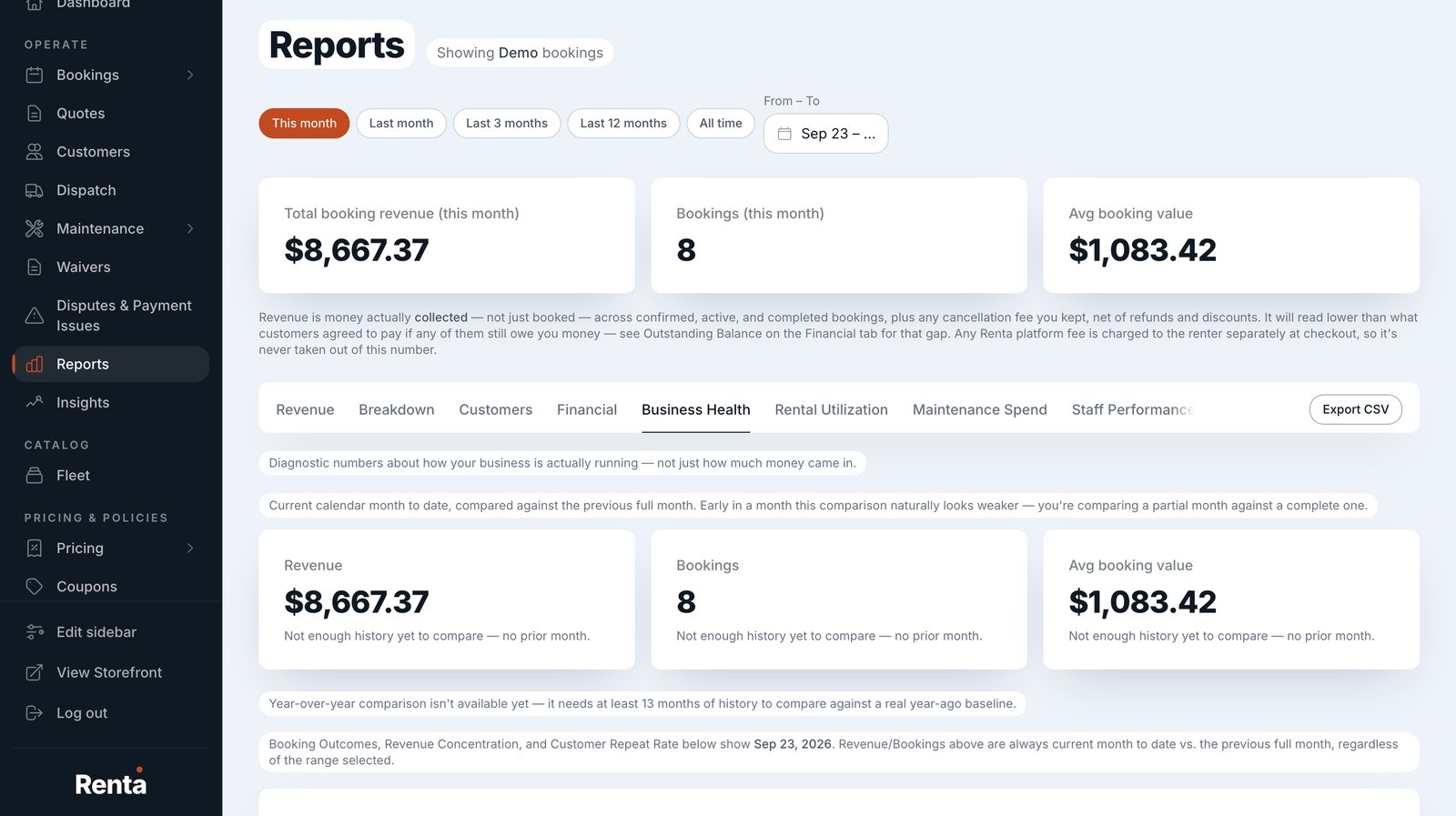
Revenue, bookings, and business-health reports are built into the admin (demo account, sample data).
Automated booking emails
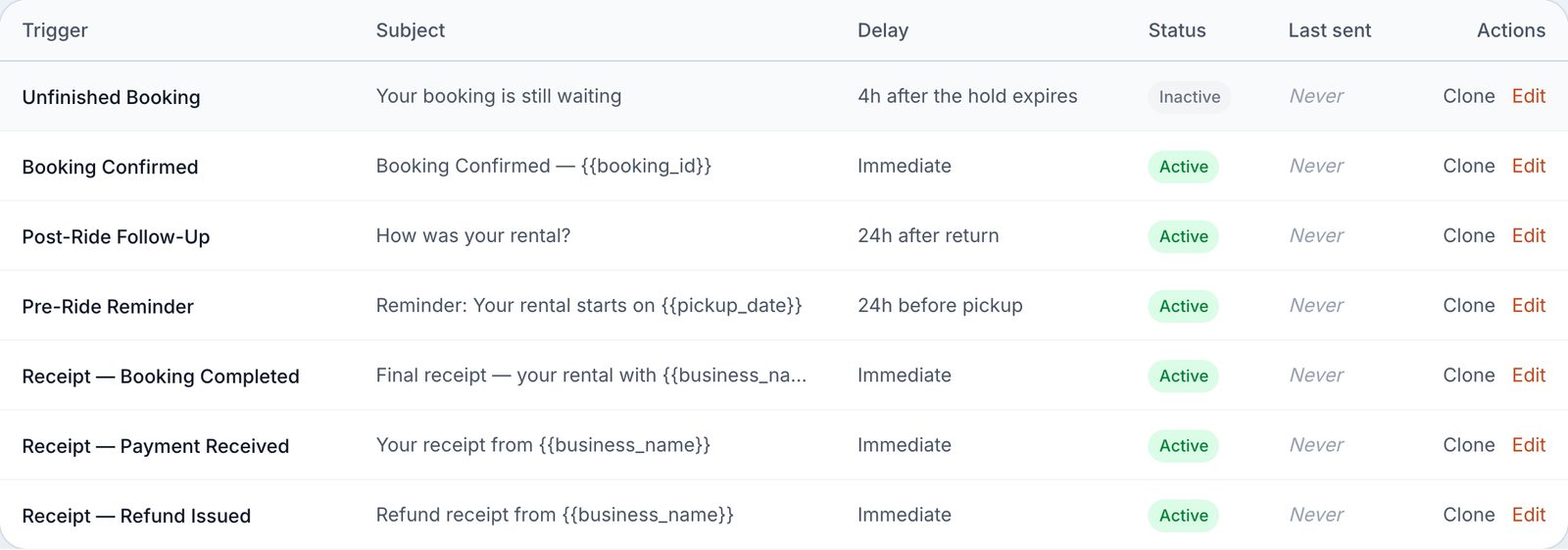
Automated emails for confirmations, reminders, receipts, and post-ride follow-ups (demo account).
Frequently Asked Questions
What is the main difference between Renta and Rentman?
Rentman is built for AV, event, and production companies to schedule crew, equipment, and transport for individual jobs. Renta is built for rental businesses — equipment, powersports, gear — to run a public-facing online storefront where customers book and pay directly, plus manage pricing, maintenance, and marketing in one place.
Is Rentman good for a small equipment rental business?
Rentman can work for a small business, but it's designed around project-based AV and event workflows, not a consumer-facing online booking storefront. If your customers need to browse, book, and pay online themselves, that's not what Rentman's product is built around.
How much does Rentman cost per month?
Rentman doesn't publish one flat rate. It runs on tiered subscription pricing that scales with how many inventory items you track, which add-ons you use, and how many user seats you need, and larger accounts often move to a custom quote. Because pricing depends on usage, contact Rentman directly for current numbers rather than relying on a figure quoted elsewhere.
Does Renta have a free trial or upfront cost?
Renta runs on commission-based pricing, so there's no flat monthly SaaS fee required just to get started — you're not paying a subscription before you've booked your first rental.
Can I sell rentals online and take deposits with Rentman?
Rentman's core workflow is quoting and invoicing for production jobs rather than a public online checkout, and payments/deposit-hold features aren't part of its published feature set. Renta, by contrast, is built specifically around an online storefront with Stripe Connect payments and deposit holds included.
Which is better for a powersports or outdoor gear rental shop, Renta or Rentman?
For powersports, outdoor gear, or general equipment rental where customers book and pay online, Renta is the closer fit — it's built specifically for that kind of operator, with a storefront, flexible pricing, and a maintenance tracker tied to usage meters. Rentman is the stronger fit if your business is really an AV or event production company that needs crew and transport scheduling alongside equipment.