Renta and HireHop are both cloud-based rental management platforms, but they're built for different-shaped businesses. HireHop is a UK-based system built for operationally complex, inventory-heavy rental fleets — think AV and event production, film and TV gear, construction, and plant/tool hire — with deep stock tracking, crew scheduling, and maintenance management baked in. Renta is built for equipment, powersports, and gear rental operators who want a simpler all-in-one platform: booking, payments, a real website, and marketing tools under one login, priced around what you actually rent out rather than a flat per-seat fee.
The short version: if your operation needs job costing, crew allocation, and deep asset hierarchies across departments, HireHop's maturity in that specific lane shows. If you want a customer-facing storefront live fast, simpler pricing rules, and marketing data without stitching together separate tools, Renta is the more direct starting point.
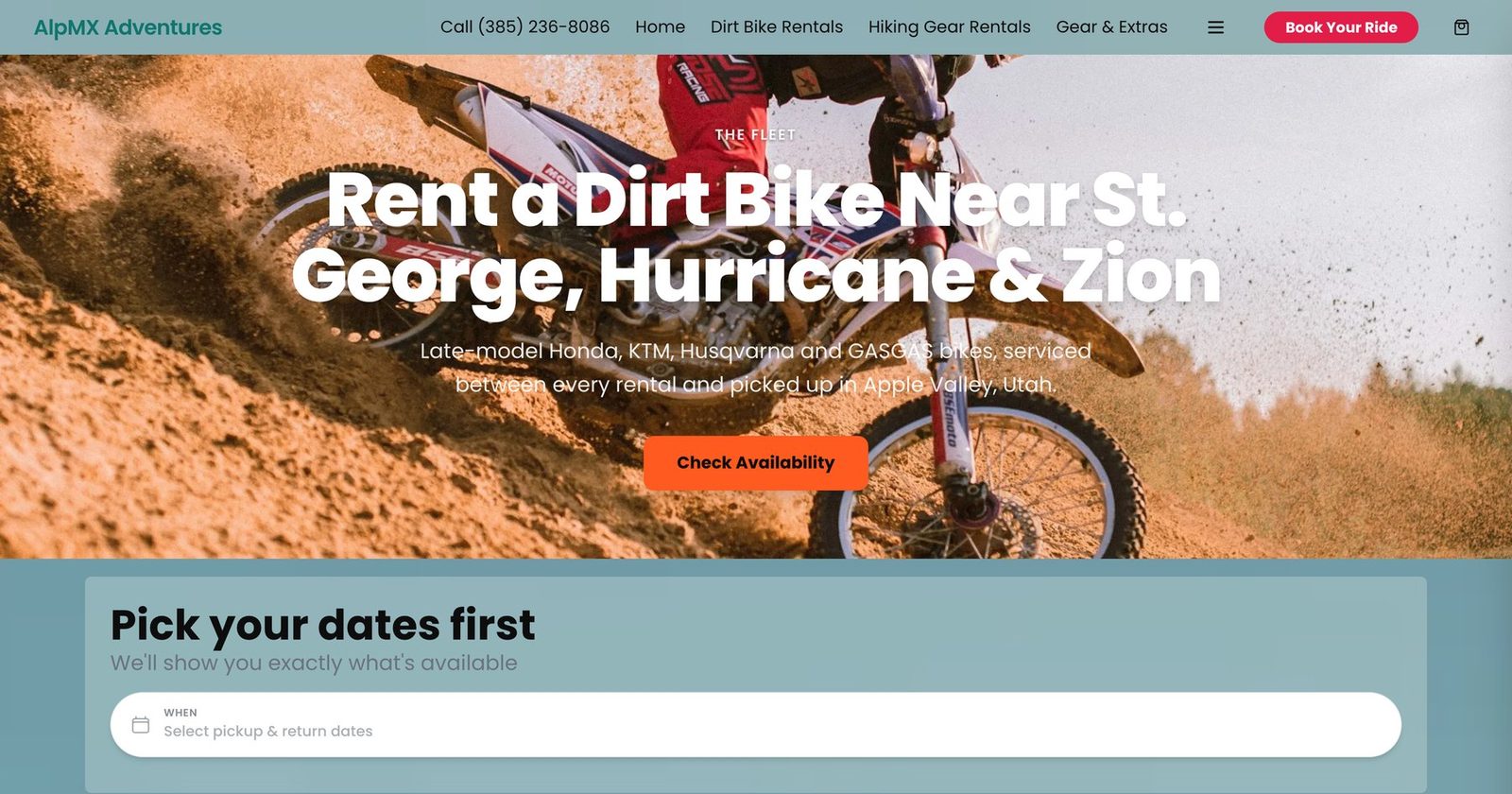
alpmxadventures.com, a live rental business site built with Renta's website builder.
Quick Answer: Who Should Pick Which
Pick HireHop if: you run a large, department-heavy rental operation — an AV/events company, a plant or tool hire yard, or a film/TV equipment house — where the hard problem is tracking thousands of individual assets, allocating crew to jobs, and syncing all of it into Xero, QuickBooks, or Sage. HireHop has been solving that specific problem for a long time and it shows in the depth of its stock and job-scheduling tools.
Pick Renta if: you're renting equipment, powersports gear, or similar physical inventory directly to consumers or small businesses, and you want the booking website, payment processing, waiver collection, and marketing reporting to live in one admin instead of three or four subscriptions. Renta is newer and doesn't yet have HireHop's years of enterprise fleet-management depth, but for a storefront-driven rental business it's a more complete package out of the box.
Feature-by-Feature Comparison
| Feature | Renta | HireHop |
|---|---|---|
| Best for | Equipment, powersports, and gear rental businesses that need an online storefront | Inventory-heavy fleets: AV/events, film & TV, construction, plant/tool hire |
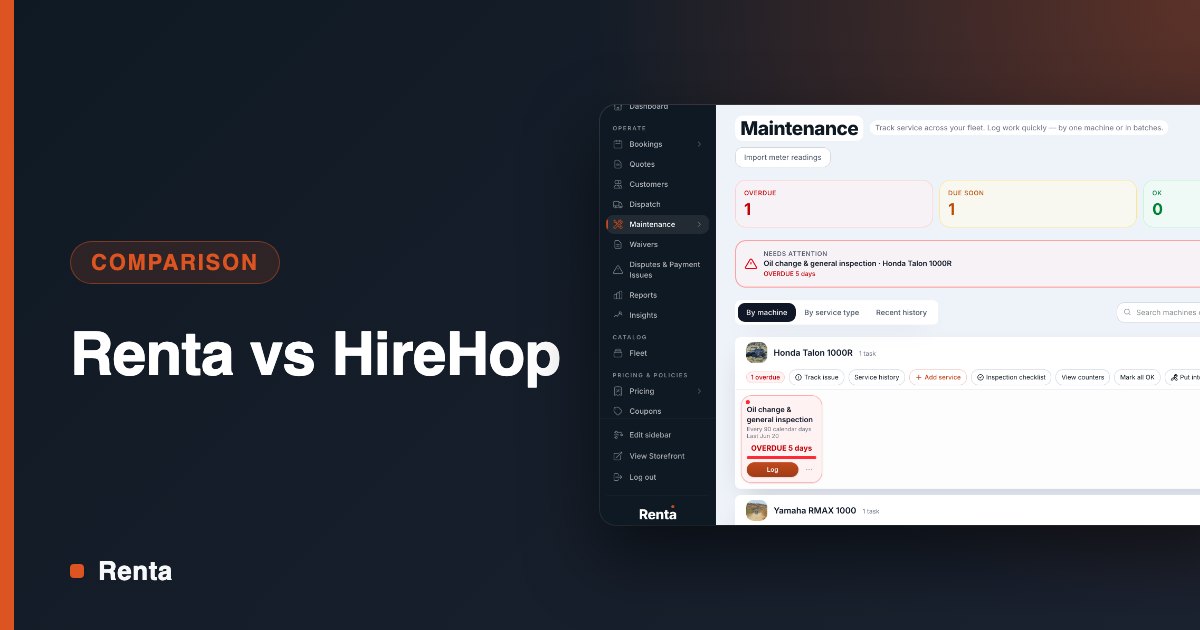
| Inventory & maintenance | Per-unit schedules tied to real usage meters (engine hours or mileage), automatic overdue/due-soon/ok status, a logged service that resets the schedule, and a maintenance-spend report | Deep stock and asset tracking built for complex fleets, plus maintenance scheduling and crew/job allocation across departments |
| Pricing model | Commission-based; no flat SaaS fee required to start | Flat monthly fee per user, plus a limited free single-user plan |
| Website / storefront | Built-in page builder — operators design and publish real pages that double as the live booking storefront | Focused on back-office quoting, scheduling, and invoicing; not positioned as a website or storefront builder |
| Payments | Stripe Connect with deposit holds, dispute tracking, and gift cards | Invoicing with accounting sync; no dedicated online deposit-hold/payment system in its published feature set |
| Marketing & analytics | Built-in dashboard: revenue by period/category, acquisition sources, repeat-customer rate, plus native GA4, Search Console, and PageSpeed summaries in the same admin | Not positioned as a marketing or storefront analytics tool — its strength is operations, not customer acquisition |
| Accounting integration | QuickBooks Online sync | Xero, QuickBooks, and Sage sync built in |
| Delivery & multi-location | Multi-location pickup plus a delivery dispatch board with driver assignment | Not positioned as a delivery-dispatch or multi-location pickup tool — its focus is internal stock and job logistics |
| Customer communication | Unified customer inbox, automated waiver-signature requests, automated post-rental review requests, and quotes with built-in expiry dates | Quoting and invoicing are core strengths; automated waiver and review-request workflows aren't part of its published feature set |
| Support | In-app support through the admin | Free phone and email support included at no extra cost |
Pricing: How Renta and HireHop Charge You
HireHop's published pricing (per Capterra and GetApp) starts at roughly £46/month (about $63 USD) for the first user, with each additional user costing about £23/month (about $31.50 USD). There's a limited free single-user plan and a free trial, and no setup or implementation fees. Once you're running a larger, multi-department operation, HireHop moves to custom enterprise pricing that isn't publicly listed — you'd need to talk to their sales team for that number.
Renta works differently: it runs on commission-based pricing, which means there's no flat monthly subscription or per-seat fee required just to get started. You're not paying more as you add staff logins the way you would with HireHop's per-user model — the cost scales with what you're actually booking. That's a meaningfully different bet depending on your business: if you already have a large back-office team, a flat per-user fee can end up predictable and cheaper at scale; if you're growing and don't want a fixed monthly cost regardless of bookings, a commission model removes that risk early on.
Where HireHop Is Genuinely Better
HireHop earns its reputation in one specific area: operationally complex fleets with a lot of moving parts. If you're allocating specific serialized assets to specific jobs, tracking crew alongside equipment, and need maintenance records and availability checks that hold up across construction sites or event productions, HireHop's stock and job-scheduling tools are purpose-built for that and have had years to mature. Its accounting sync with Xero, QuickBooks, and Sage covers more bookkeeping platforms than most competitors bother to support. Reviewers on Capterra give it a strong 4.9/5 average, and free phone and email support included at no extra cost is genuinely unusual in this category — most rental platforms push support into a paid tier. For a business whose core problem is "manage thousands of assets across departments," that combination is hard to beat.
Where Renta Is Genuinely Better
Renta's advantage is breadth for a storefront-driven business. The website builder isn't a fixed template — operators build and publish their own pages and control their brand's look and feel, and that same site is where customers actually book, not a separate marketing page bolted onto a back-office tool. Pricing can run as simple day-rates, hourly with daily caps, half-day slots, or fixed packages, layered with seasonal, multi-day-discount, day-of-week, and bundle pricing rules, plus add-ons (flat fee, per-day, percent-of-item, or multi-choice) and coupons that can be capped per customer, per category, or per item — flexibility that matters when your rental catalog isn't one-size-fits-all. Payments run through Stripe Connect with deposit holds, dispute tracking, and gift cards built in, and the marketing dashboard means you can see revenue by period and category, where customers are coming from, your most-popular items, and your repeat-customer rate without logging into a separate analytics tool — it even pulls in Google Search Console, GA4, and PageSpeed summaries natively. For operators running more than one pickup point, there's a delivery dispatch board with driver assignment. Day-to-day communication runs through a unified customer inbox, with automated waiver-signature requests, automated post-rental review requests, and quotes that carry their own expiry date — follow-up that HireHop's published feature set doesn't appear to automate the same way.
A Few Things Worth Knowing Before You Commit
Honesty matters more than a sales pitch here. HireHop's own users describe a steep learning curve when first setting up inventory, templates, and price structures — some call the initial setup inflexible or non-intuitive — and the interface reads as dated compared to newer SaaS tools. Users also mention its mobile experience is more limited than the desktop app, particularly on smaller screens, and some report friction creating purchase orders since there's no easy way to copy one from a prior order.
Renta has its own honest limitation: it's a newer platform than HireHop, which means a smaller install base and fewer third-party integrations or marketplace listings than a longer-established competitor. Its extension ecosystem is still growing rather than mature. Renta is strongest today for equipment, powersports, and gear rental operators — it's less proven for very large, multi-department enterprise fleets, which is exactly the space where HireHop has spent years building depth. If that's your situation, weigh both carefully rather than assuming either platform automatically wins.
See Renta in Action
Here is what the software actually looks like. Screens marked "demo account" come from Renta's demo shop with sample data, so every customer name shown is fictional.
Customer records
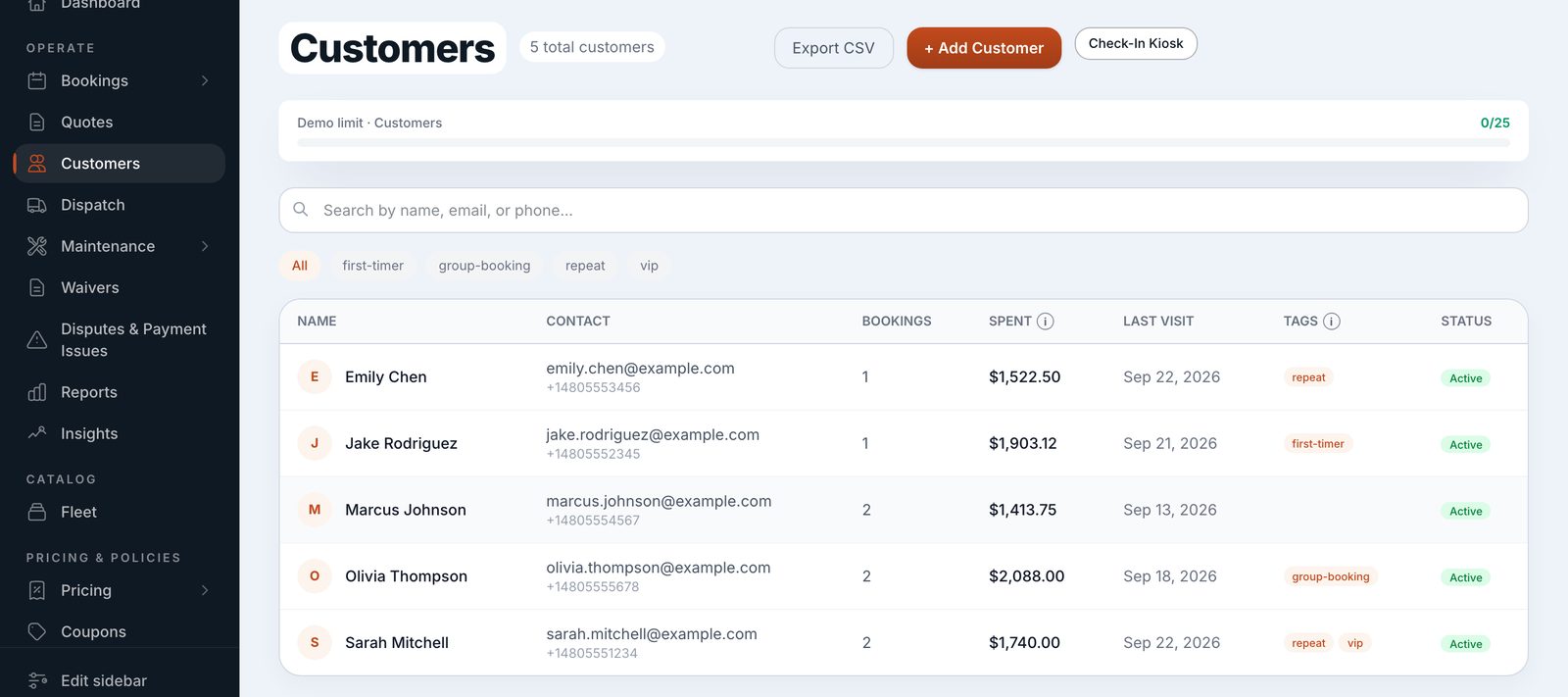
Customer records with booking history, lifetime spend, and tags (demo account; all names and contact details are fictional).
Booking dashboard
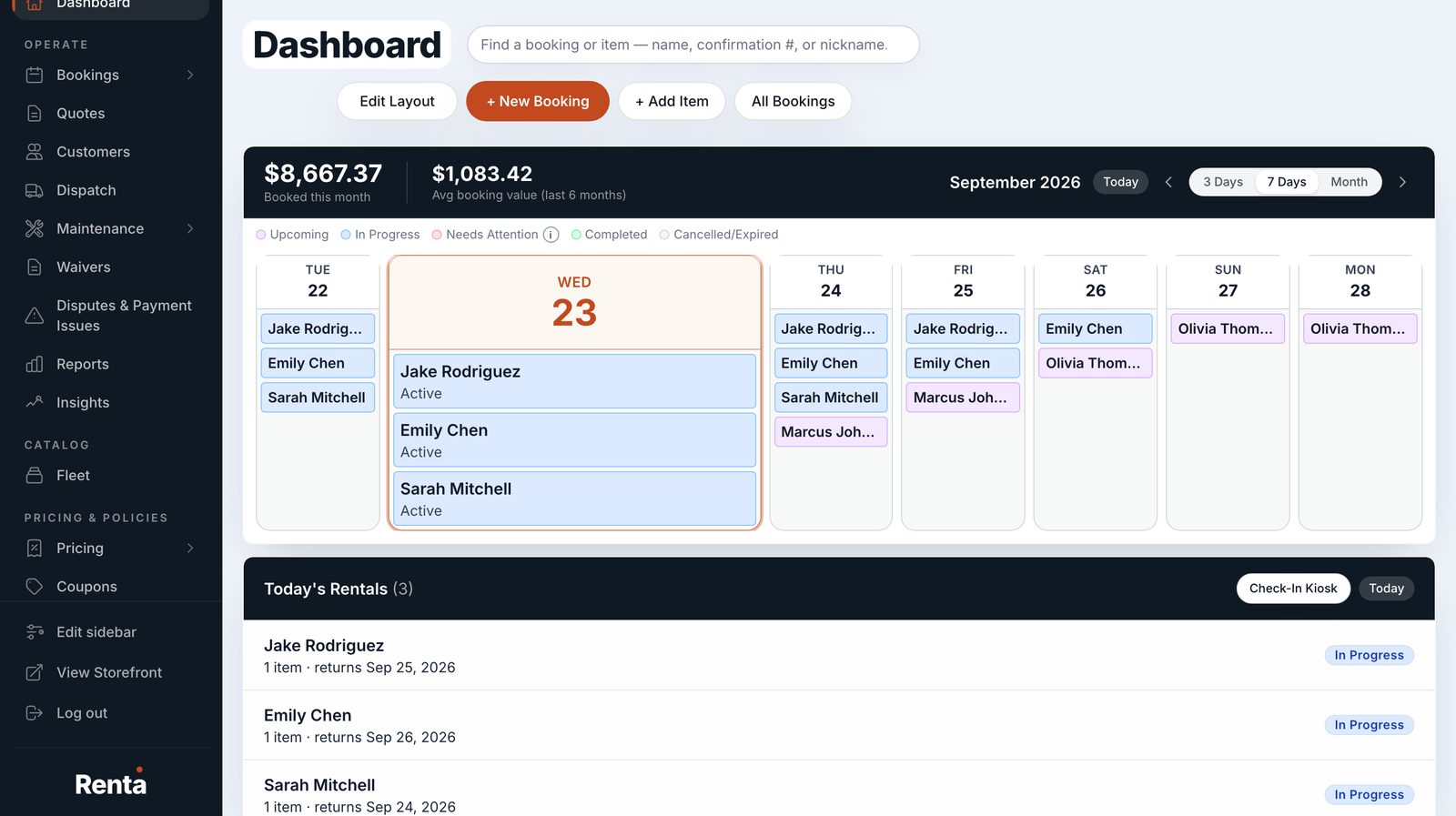
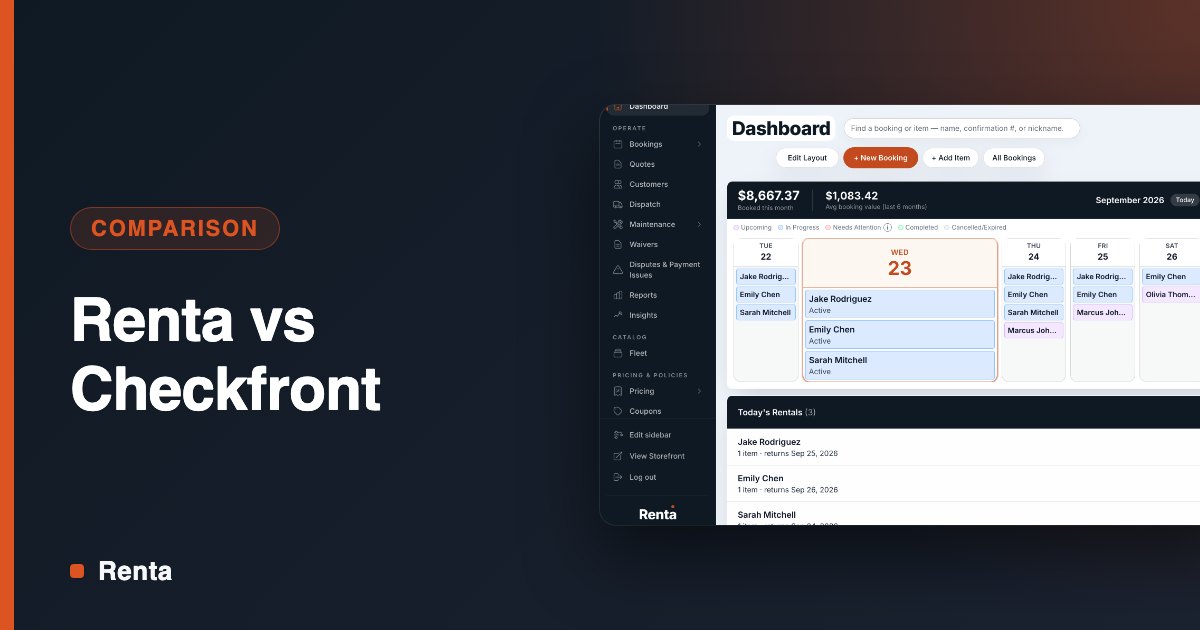
Renta's booking dashboard: a live calendar and today's rentals at a glance (demo account, sample data).
Frequently Asked Questions
Is HireHop good for equipment rental businesses?
Yes, particularly for operationally complex fleets like AV/events, film and TV, construction, and plant or tool hire, where deep stock tracking, crew scheduling, and maintenance records matter most. For a simpler, storefront-driven equipment rental business, a platform like Renta that bundles booking, payments, and marketing may fit more directly.
How much does HireHop cost?
HireHop's listed pricing starts around £46/month (about $63 USD) for the first user, with additional users at about £23/month (about $31.50 USD) each. There's a limited free single-user plan and a free trial, with no setup fees, though larger deployments use unpublished custom enterprise pricing.
Does Renta integrate with accounting software like HireHop does?
Renta syncs with QuickBooks Online. HireHop supports a wider range of accounting platforms — Xero, QuickBooks, and Sage — which is a genuine advantage for businesses already committed to one of those systems outside QuickBooks.
Can I switch from HireHop to Renta?
Businesses do migrate between rental platforms, though the right fit depends on how complex your current inventory and job-scheduling setup is. If your business runs mostly on equipment bookings rather than multi-department asset allocation, Renta's storefront-first setup is typically a more direct switch.
Which is better for a small rental business, Renta or HireHop?
For a smaller, single-location equipment or gear rental business, Renta's commission-based pricing avoids a flat monthly fee before you've booked anything, and its built-in website and marketing dashboard reduce the number of separate tools you need. HireHop's strengths are more valuable once your operation grows into multi-department asset and crew management.
Does Renta have a website builder like HireHop?
Renta includes a real website builder that doubles as the live booking storefront — operators control the theme and publish their own pages. HireHop is built around back-office quoting, scheduling, and invoicing rather than a customer-facing website.