The best equipment rental software in 2026 depends on your fleet size and how much setup time you want to spend — there isn't one platform that wins for every business. For small-to-midsize general equipment rental (tools, outdoor gear, party and event equipment), Booqable and Renta stand out for fast setup and built-in online storefronts. For construction and tool-heavy operations, Quipli's flat-fee model is worth a look. For large, multi-location fleets, Point of Rental's inventory depth is hard to match.
Below we compare seven real, currently-operating platforms — pricing, standout features, and honest limitations for each — so you can pick based on your actual business, not a marketing page.
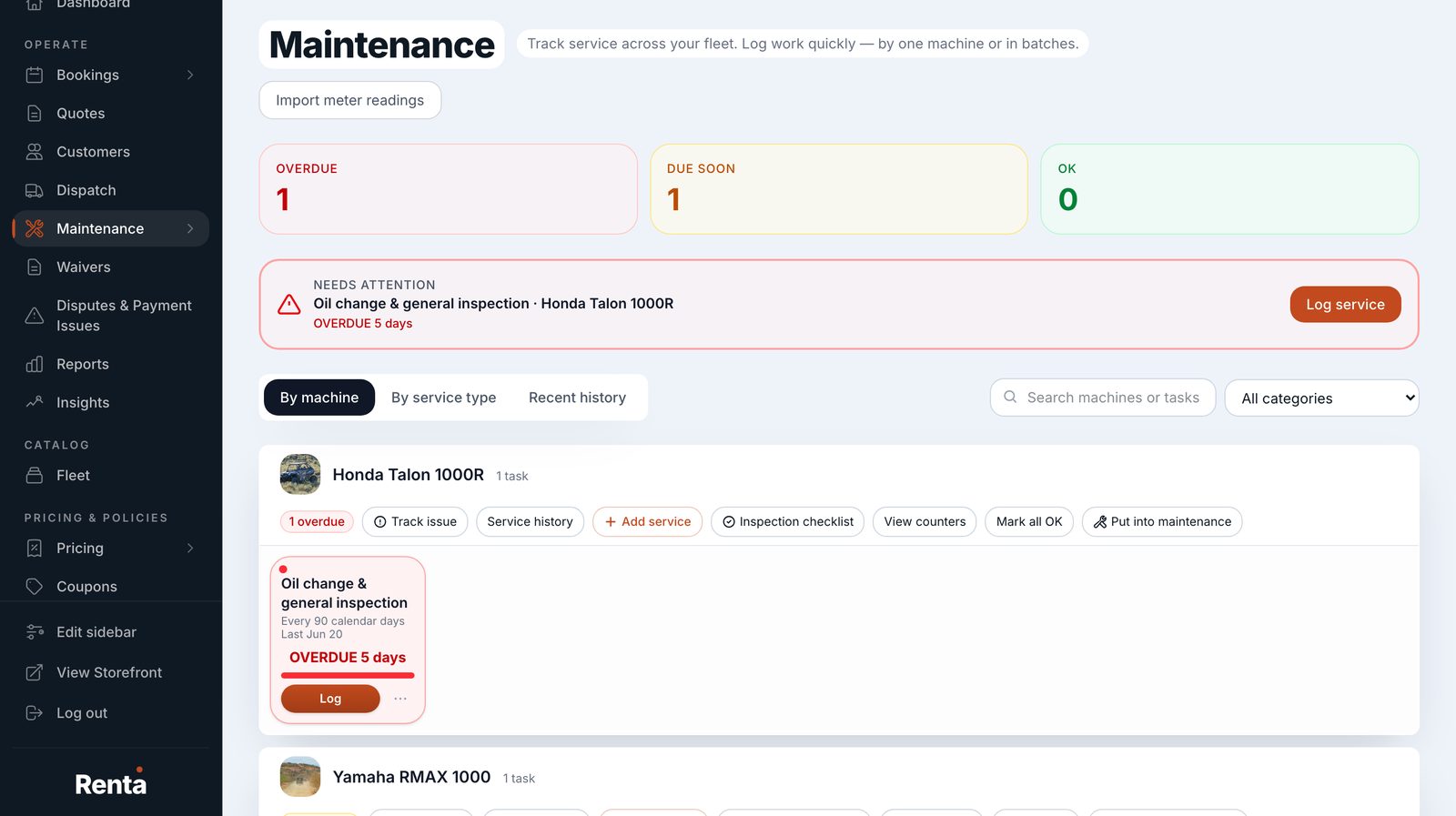
Renta's maintenance tracker flags overdue and due-soon service, machine by machine (demo account, sample data).
Equipment Rental Software Comparison at a Glance
Published pricing on rental software changes often and many vendors gate final numbers behind a custom quote, so treat the figures below as directional starting points and confirm current pricing directly with each vendor before you commit.
| Platform | Best For | Standout Feature | Honest Limitation |
|---|---|---|---|
| Booqable | Small-to-midsize general rental businesses | Embeddable storefront and checkout widget | Mobile app noticeably weaker than desktop |
| Renta | Equipment, powersports, and gear rental operators | Built-in marketing dashboard + real website builder | Newer platform, smaller install base and integration ecosystem |
| Quipli | Construction and tool rental | Flat annual pricing, no per-user fees | Initial setup is labor-intensive; QuickBooks sync is limited |
| EZRentOut | Budget-conscious small operators | Strong price-to-feature ratio | Steep jump between tiers; mobile app lags desktop |
| Point of Rental | Large, complex multi-location fleets | Deep inventory categorization and custom fields | No public pricing; support responsiveness has declined |
| Rentman | AV, event, and crew equipment scheduling | Real-time availability and scheduling tools | Per-user pricing gets expensive as teams grow |
| Checkfront | Booking-first operators (rental, tours, hospitality) | Flexible booking engine, no per-booking fees | Bug reports and slow support on critical issues |
1. Booqable — Best Overall for Small-to-Midsize General Rental Businesses
Booqable is the platform most operators in party, tool, and outdoor-gear rental have already heard of, and the reputation is earned: reviewers consistently say you can list products, take bookings, and track inventory without needing a developer, and the embeddable storefront and checkout widget is a real differentiator that lets you sell rentals from an existing website rather than replacing it. Booqable says over 8,000 rental businesses use it, which is a meaningful signal of how battle-tested the core workflow is. The trade-off shows up on mobile — the phone and tablet app is consistently described as clunkier and missing features compared to the desktop experience, which matters if your team checks in equipment from the yard rather than a desk. Published pricing runs roughly Start at $29/mo, Grow at $69/mo, and Scale at $149/mo, with a 14-day free trial and an annual-billing discount — confirm current numbers on booqable.com/pricing since these shift.
2. Renta — Best for Equipment, Powersports, and Gear Rental Operators Who Want Marketing Built In
Renta is a newer entrant, and we'll say that plainly rather than bury it: it has a smaller install base and fewer third-party integrations than Booqable or Point of Rental, and its extension ecosystem is still growing. Where it earns a spot on this list is in what's built into the core product rather than bolted on. Pricing can run as simple day-rates, hourly with daily caps, half-day slots, or fixed packages, layered with seasonal, multi-day, day-of-week, and bundle pricing rules — useful if your rate card is more complicated than a flat daily fee. The admin includes a marketing dashboard with revenue-by-category, customer acquisition sources, repeat-customer rate, and native Google Search Console, GA4, and PageSpeed summaries, so you're not logging into three other tools to see how the business is doing. A maintenance tracker ties service schedules to actual engine hours or mileage rather than the calendar, which matters for powersports and heavy equipment specifically. Automated waiver requests, review requests, and quote sending with expiry cut down on manual follow-up, and the website builder is a real page builder — not a fixed template — that doubles as the storefront where bookings happen. Stripe Connect payments with deposit holds, gift cards, QuickBooks Online sync, and commission-based pricing (no flat SaaS fee required to start) round it out. It's strongest today for equipment, powersports, and gear rental operators specifically, and less proven yet for large, multi-department enterprise fleets.
3. Quipli — Best Flat-Fee Option for Construction and Tool Rental
Quipli is the closest direct category peer to Renta on this list, built specifically for construction, tool, and equipment rental rather than a broader booking category. Its flat annual pricing model — publicly stated at roughly $6,000 per location per year, with no separate charges for support, onboarding, or extra users — is called out by users as refreshingly predictable next to per-user competitors, and the SEO-optimized storefront paired with maintenance tracking is a combination reviewers frequently praise together. The honest downside: initial inventory and pricing setup is described as labor-intensive, and its QuickBooks integration is still limited, which is worth testing directly if your bookkeeping already runs through QuickBooks.
4. EZRentOut — Best Budget-Friendly Pick
EZRentOut's biggest selling point, according to its own reviewers, is straightforward: price-to-feature value, alongside a user-friendly interface and responsive support, across its three published tiers — Essential at roughly $59/mo, Growth at roughly $399/mo, and Premium at roughly $499/mo. That jump from Essential to Growth is steep and worth budgeting for before you commit, since it can force an early re-evaluation as you add locations or users. Setup and customization take real time, and reviewers flag invoicing bugs, limited reporting flexibility, and a mobile app that lags the desktop version — similar complaints to Booqable's mobile gap.
5. Point of Rental — Best for Large, Complex Multi-Location Fleets
Point of Rental is one of the longest-established names in this space, and its standout strength reflects that maturity: inventory management depth, with granular categories, sub-categories, and custom fields for tracking many equipment types across multiple locations. That makes it a genuine fit for larger or more complex fleets that have outgrown simpler tools. The catch is that pricing is entirely custom-quote — nothing is published — which is itself worth factoring in if you want to comparison-shop quickly. Multiple recent reviews also describe declining support responsiveness: slower ticket resolution, difficulty reaching a live person, and in some plans extra fees for phone support.
6. Rentman — Best for AV, Event, and Crew Equipment Scheduling
Rentman is ranked #1 in SelectHub's equipment rental software directory, and it earns that with a genuinely intuitive interface, strong real-time availability and scheduling tools, and responsive support through live training and multiple channels. It's worth being clear about fit, though: Rentman is built primarily for AV, event production, and crew/equipment scheduling rather than general equipment rental, so it's a stronger match if your business revolves around scheduling people and gear together rather than renting standalone units. Its per-user pricing — Crew Essential from roughly $14/user/mo, Inventory from roughly $19/user/mo, Suite at roughly $39/mo flat — draws real complaints from smaller teams, since adding "Power" users or extra modules can get expensive fast and makes costs less predictable as you grow.
7. Checkfront — Best When Booking Flexibility Matters More Than Inventory Depth
Checkfront sits a step outside pure equipment rental — it's a booking and reservation platform used across rental, tours, and hospitality more broadly — but it's a legitimate option if what you need most is a flexible booking engine with straightforward integrations and no extra per-booking or per-user fees, a real contrast to platforms that charge per transaction. The honest weak points are recurring: technical bugs, slow support response on critical issues, limited reporting customization, and user complaints that recent price increases have hurt the value proposition. Pricing is genuinely unclear across sources — some list roughly $49/mo, others cite a $225/mo flat rate, with a custom-priced Enterprise tier — which suggests pricing has recently changed or split into new tiers, so verify directly with Checkfront before budgeting around either number.
How to Choose Between Them
Match the platform to what actually slows your business down today. If checkout and getting a storefront live fast is the bottleneck, Booqable or Renta will get you there quickest. If your rate card is genuinely complex — seasonal pricing, bundles, multi-location delivery — look hard at how each platform handles pricing rules before you sign anything, since that's where cheaper tools start to strain. If you're running a large, multi-department fleet, Point of Rental's inventory depth is worth the custom-quote process. And if support quality matters more to you than any single feature, ask each vendor for references from businesses your size — the support complaints above cluster around specific plan tiers, not entire companies.
See Renta in Action
Here is what the software actually looks like. Screens marked "demo account" come from Renta's demo shop with sample data, so every customer name shown is fictional.
Reports and business health
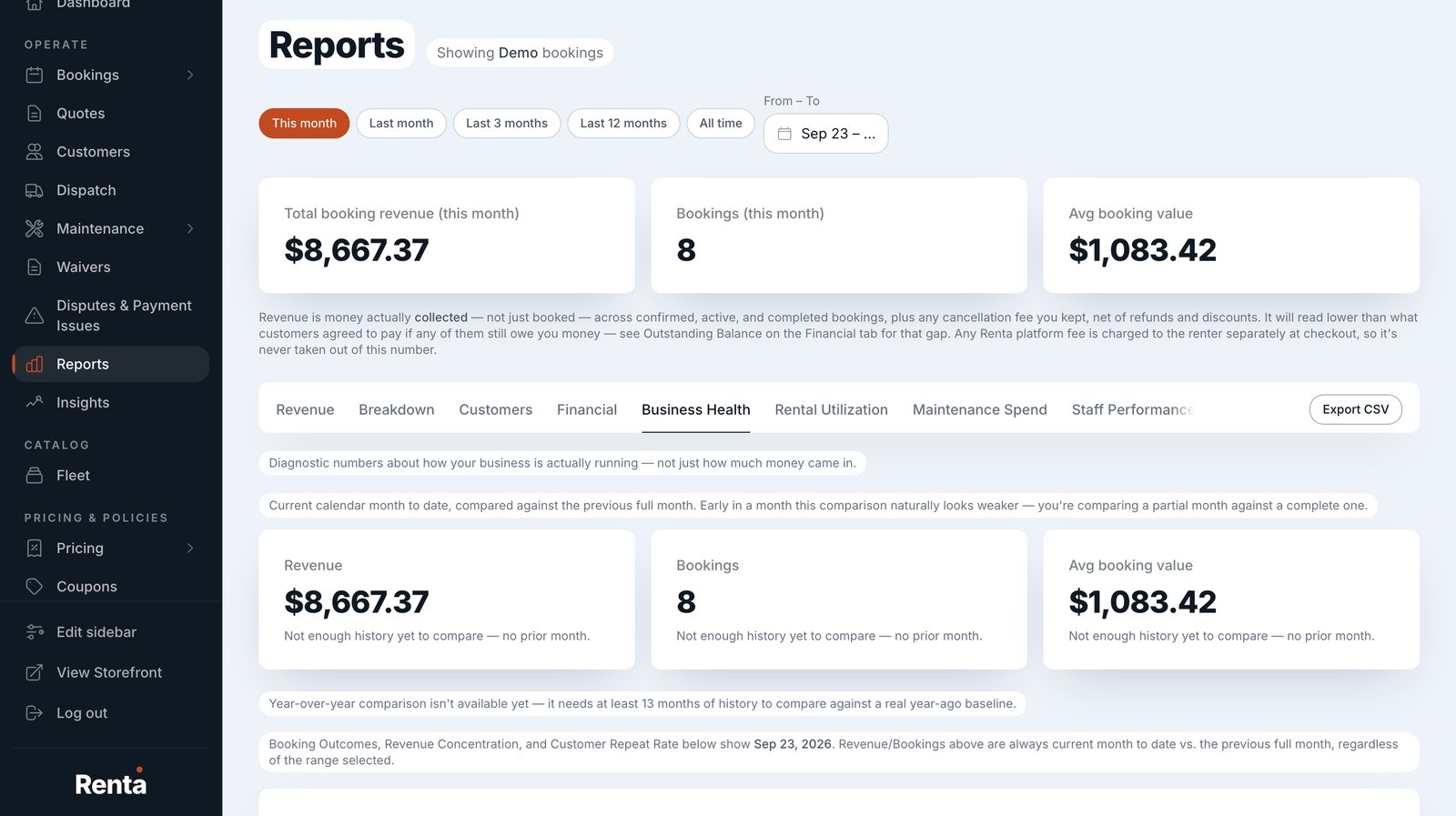
Revenue, bookings, and business-health reports are built into the admin (demo account, sample data).
Customer records
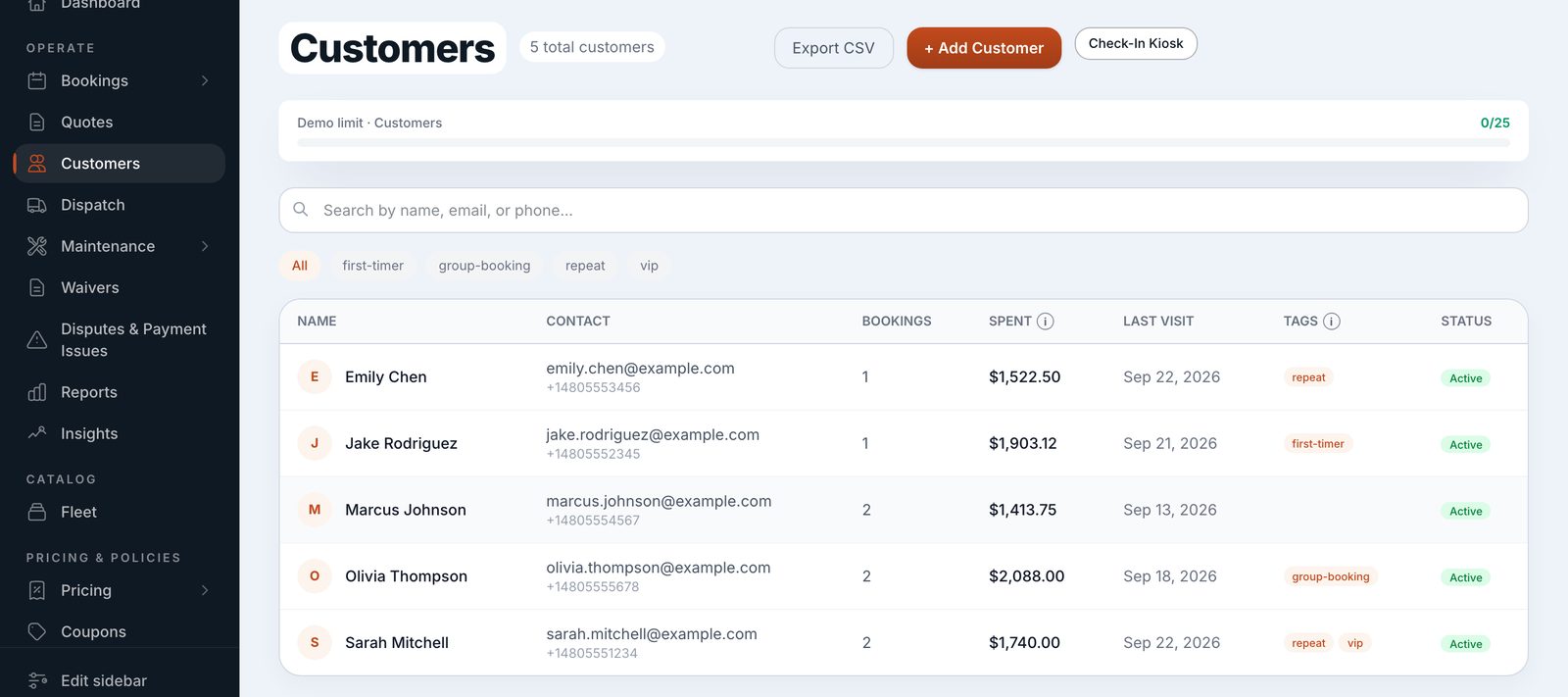
Customer records with booking history, lifetime spend, and tags (demo account; all names and contact details are fictional).
Frequently Asked Questions
What is the best software for an equipment rental business?
There's no single best option for every business — it depends on your fleet size and priorities. Booqable and Renta are strong picks for small-to-midsize general equipment rental thanks to fast setup and built-in storefronts, Quipli suits construction and tool rental with flat-fee pricing, and Point of Rental fits large, complex multi-location fleets.
How much does equipment rental software cost?
Published starting prices for the platforms in this list range from roughly $29/month (Booqable) to flat annual fees near $6,000/location (Quipli), with several vendors like Point of Rental only offering custom quotes. Most platforms also charge more as you add users, locations, or advanced modules, so get a quote based on your actual fleet size before comparing sticker prices.
Is Booqable good for equipment rental?
Yes — Booqable is widely used for equipment, party, and outdoor-gear rental and is praised for being fast to set up without technical help, plus an embeddable storefront and checkout widget many competitors lack. Its main weak point is the mobile app, which reviewers describe as noticeably behind the desktop experience.
What's the difference between Renta and Booqable?
Both target small-to-midsize rental businesses with a storefront and booking system, but Renta bundles more operational tooling directly into the core product — a marketing dashboard with GA4/Search Console data, a maintenance tracker tied to real usage meters, and a full page-builder website — while Booqable has a longer track record and a larger existing user base. Renta is newer and has fewer third-party integrations today, so businesses that rely heavily on existing add-ons should check integration availability first.
Does equipment rental software handle deposits and damage waivers?
The stronger platforms do, but coverage varies — Renta, for example, supports Stripe Connect payments with deposit holds and automated waiver-signature requests (single-signer or per-rider) built into the same system. Always confirm deposit-hold and waiver handling directly with a vendor rather than assuming it's included, since it's often gated to higher-priced tiers.
Do I need special software to run a rental business, or can I use spreadsheets?
Spreadsheets can work for a handful of items, but they break down fast once you're tracking availability across multiple units, taking online bookings, or collecting deposits and waivers — double-bookings and missed maintenance become common. Dedicated rental software automates availability checks, payments, and customer communication in one place, which is usually worth it once you're managing more than a few dozen rentable items.