The best rental software platform for most businesses in 2026 depends less on which company has the flashiest feature list and more on how it prices itself. Flat-fee platforms like Booqable, Renta, Quipli, and HireHop charge a predictable subscription (a fixed monthly fee) regardless of how many bookings you close. Checkfront blends the two models — a flat monthly plan plus a smaller per-booking fee — while commission-based platforms like Peek Pro charge nothing upfront and instead take a cut of every transaction. For a rental business planning to grow, that single difference in pricing model usually matters more than any individual feature. Below we rank six real platforms — including our own — with an honest verdict on each, because every one of them has genuine strengths and real trade-offs.
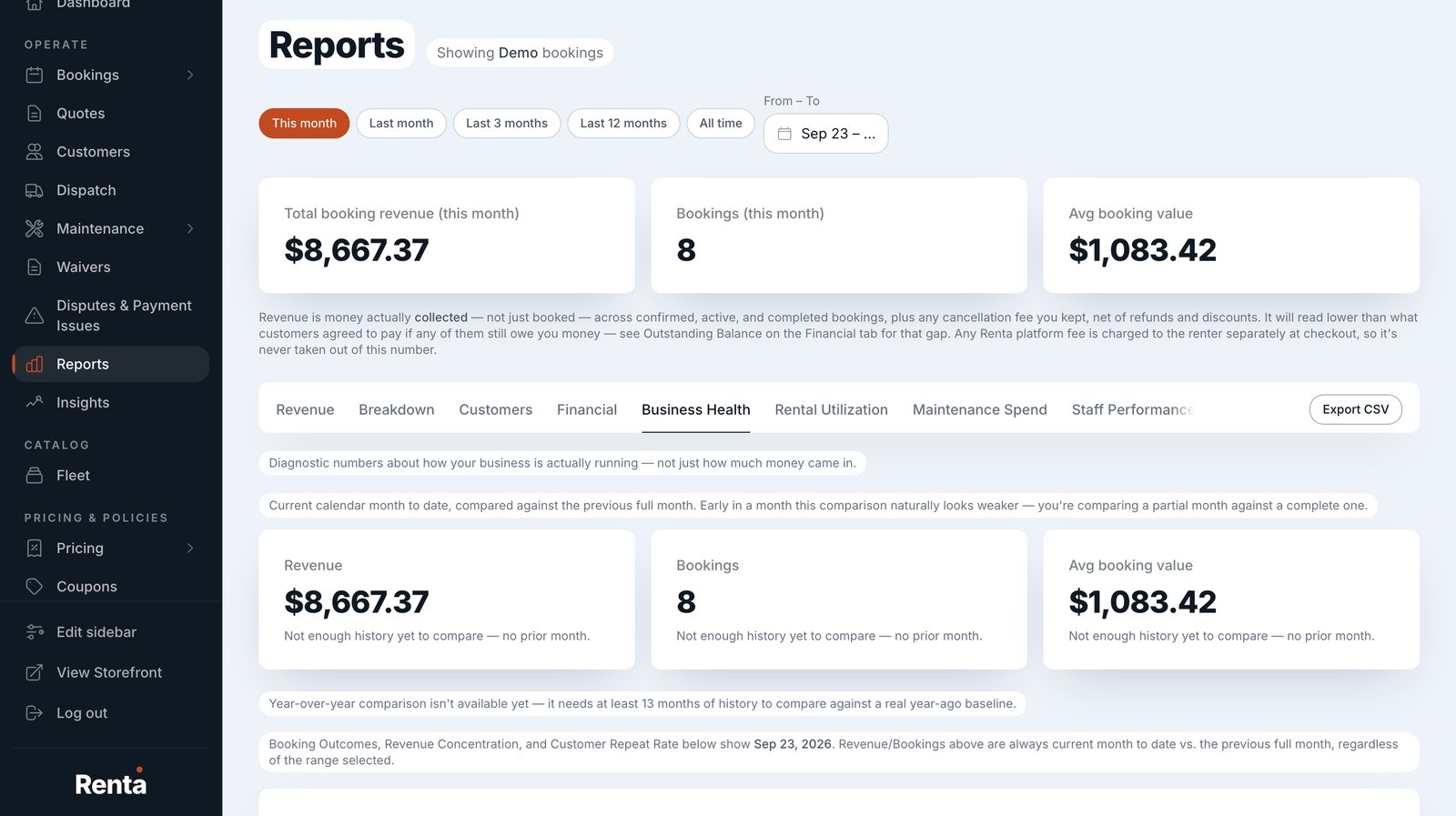
Revenue, bookings, and business-health reports are built into the admin (demo account, sample data).
We looked at public pricing pages, independent user reviews, and — since we build Renta — our own firsthand product knowledge to write the verdicts below. No platform on this list gets a pass, including us: we'll tell you where Renta falls short right alongside where it's a genuinely good fit. The rental and equipment industry keeps growing, and competition has pushed most platforms to cover the booking, inventory, and payment basics reasonably well. The real differences show up over time — whether support stays responsive after the sales call, whether pricing stays reasonable as your booking volume climbs, and whether the platform was actually built for your kind of rental business instead of adapted from a generic scheduling tool.
The 6 Best Rental Software Platforms, Ranked
1. Booqable — Best All-Around Platform for Small Rental Businesses
Booqable is the most polished, widely-used option on this list, and it's a reasonable default answer to "what rental software should I use." It covers inventory, online booking, checkout, and an embeddable storefront in one place, and reviewers consistently describe it as intuitive to set up, with responsive support including live chat and AI-assisted help. Where it falls short is pricing at scale: the jump between tiers gets steep for a growing small business, and some operators report gaps around e-signature contracts, security deposit handling, and importing existing inventory data. It's a strong starting point for events, bounce houses, and general equipment rental — just budget for the tier jump before you outgrow the entry plan.
2. Renta — Best for Equipment, Powersports, and Gear Rental Operators
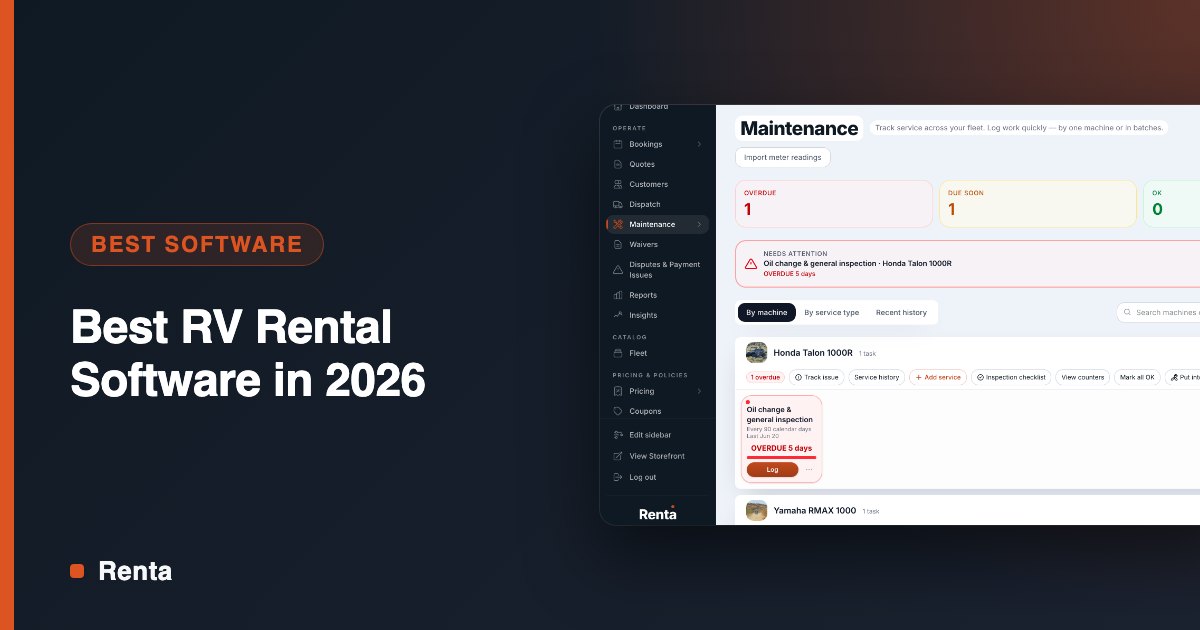
Renta (that's us) is built specifically for equipment, powersports, and gear rental operators — think ATV and boat rentals, bike shops, and camera or AV gear — rather than being a general scheduling tool adapted to fit. The parts of the product that matter most for that kind of business are easy to miss in a feature list: a maintenance tracker tied to actual engine hours or mileage that automatically flags overdue and due-soon service, a built-in marketing dashboard showing revenue by category and where customers actually came from without a separate Google Analytics login, and pricing flexible enough to run day-rates, hourly caps, seasonal rules, multi-day discounts, and bundles without a workaround. Renta also runs on Stripe Connect with deposit holds and can operate on commission-based pricing instead of a flat subscription, so a business can start without committing to a monthly fee at all. The honest trade-off: Renta is newer than Booqable or HireHop, so it has a smaller install base, fewer third-party integrations, and a still-growing ecosystem of extensions — it's strongest for equipment and gear operators specifically, and less proven yet for large, multi-department enterprise fleets.
3. Quipli — Best for Independent Construction and Tool Rental Yards
Quipli is purpose-built for independent construction and tool equipment rental operators, with an SEO-focused storefront, fleet management, delivery coordination, and maintenance tracking. What stands out in reviews is customer service — users consistently describe Quipli's team as responsive and willing to make product changes based on direct feedback, with onboarding and extra user seats included rather than upsold separately. The catch is accounting integration: the QuickBooks connection is a one-way sync from Quipli to QuickBooks, so any correction has to be made back in Quipli itself — a change made directly in QuickBooks won't flow back — which is real friction for a rental counter that needs to fix a mistake fast. Pricing is also flat-fee, but annual and location-based rather than monthly, starting around $6,000 per location per year — worth knowing up front if you were expecting a low-commitment monthly plan.
4. HireHop — Most Affordable Full-Featured Option
HireHop is a UK-based rental and inventory platform aimed at small event, entertainment, and construction-adjacent rental businesses, and it's consistently described as one of the more affordable, well-priced options in the category, with free support included and solid QuickBooks/Xero integration. Pricing runs roughly £46/month for the first user and about £23/month per additional user, with no setup fees and a free trial available. The trade-off is more about visibility than substance: there's simply less independent review volume for HireHop than for the bigger names here, which makes it harder to verify a specific recurring complaint beyond the general learning curve that comes with any feature-rich rental system.
5. Checkfront — Best Blended Flat-Fee-Plus-Booking-Fee Option for Activities and Rentals
Checkfront's current pricing is a monthly subscription (its Growth plan starts around $225/month) plus a 3% online booking fee that you can absorb or pass on to the customer — more predictable than a pure commission model, but not the flat, fee-free plan its reputation sometimes suggests. The honest downside shows up in day-to-day use, too — the interface is criticized as a confusing maze, with settings scattered across tabs, and some longtime users report the pricing model has drifted over time toward additional per-booking and customer fees they didn't originally sign up for, plus hidden availability rules that can quietly break a booking without warning. A 21-day free trial makes it easy to test that interface — and do the fee math — yourself before committing.
6. Peek Pro — Best If You Want No Monthly Fee (and Don't Mind Commissions)
Peek Pro is the strongest commission-based option here, with genuinely strong third-party ratings and a reputation for a clean, intuitive interface and reliable uptime. There's no monthly subscription, which lowers the barrier to starting. But the commission structure is also the top complaint: roughly 6% booking commission plus about 2.3% payment processing, for an effective cost near 8% of every dollar you bring in — and it climbs in lockstep with your revenue rather than staying fixed. Some users also report slower phone support response times and a refund system limited to account credit rather than actual cash refunds. It's a fit if you'd rather not pay anything until you get paid — just do the math on what that percentage looks like once you're doing real volume.
Rental Software Comparison Table
| Platform | Best For | Standout Feature | Honest Limitation |
|---|---|---|---|
| Booqable | General small rental businesses | Intuitive setup, responsive support | Costly tier jumps; no e-signature contracts |
| Renta | Equipment, powersports, and gear operators | Maintenance tracker + built-in marketing dashboard | Newer platform, smaller install base and integration library |
| Quipli | Independent construction/tool rental yards | Hands-on, responsive customer support | QuickBooks sync is one-way (Quipli to QBO only) |
| HireHop | Budget-conscious small rental/event businesses | Affordable per-user pricing with free support | Less independent review data to verify claims |
| Checkfront | Activity and tour businesses wanting predictable base pricing | Flat monthly plan, no complex volume tiers | Confusing settings/UI; plus a 3% booking fee on top of the subscription |
| Peek Pro | Tour operators wanting zero upfront cost | Strong reviews, clean interface, reliable uptime | Effective ~8% cost per booking that scales with revenue |
Flat Fee or Commission: Which Pricing Model Actually Costs Less?
If your average rental transaction is high-value and your margins are already thin — a multi-day equipment rental, for example — a flat monthly fee is almost always cheaper than a percentage-based commission once you clear a fairly low volume threshold. Run the math on your own numbers: on $10,000 in monthly bookings, an 8% effective commission works out to roughly $800 a month, which is more than most flat-fee tiers on this list, and that gap only grows as revenue grows. If you're just starting out and want to avoid any upfront cost while you validate demand, a commission model removes that barrier — at the cost of taking a growing bite out of every future booking. Renta is somewhat unusual among the flat-fee-first platforms here in that it can run either way: commission-based pricing is available for businesses that want to start without a subscription at all, then move to a flat plan later if that math works out better.
See Renta in Action
Here is what the software actually looks like. Screens marked "demo account" come from Renta's demo shop with sample data, so every customer name shown is fictional.
A site built with Renta's website builder
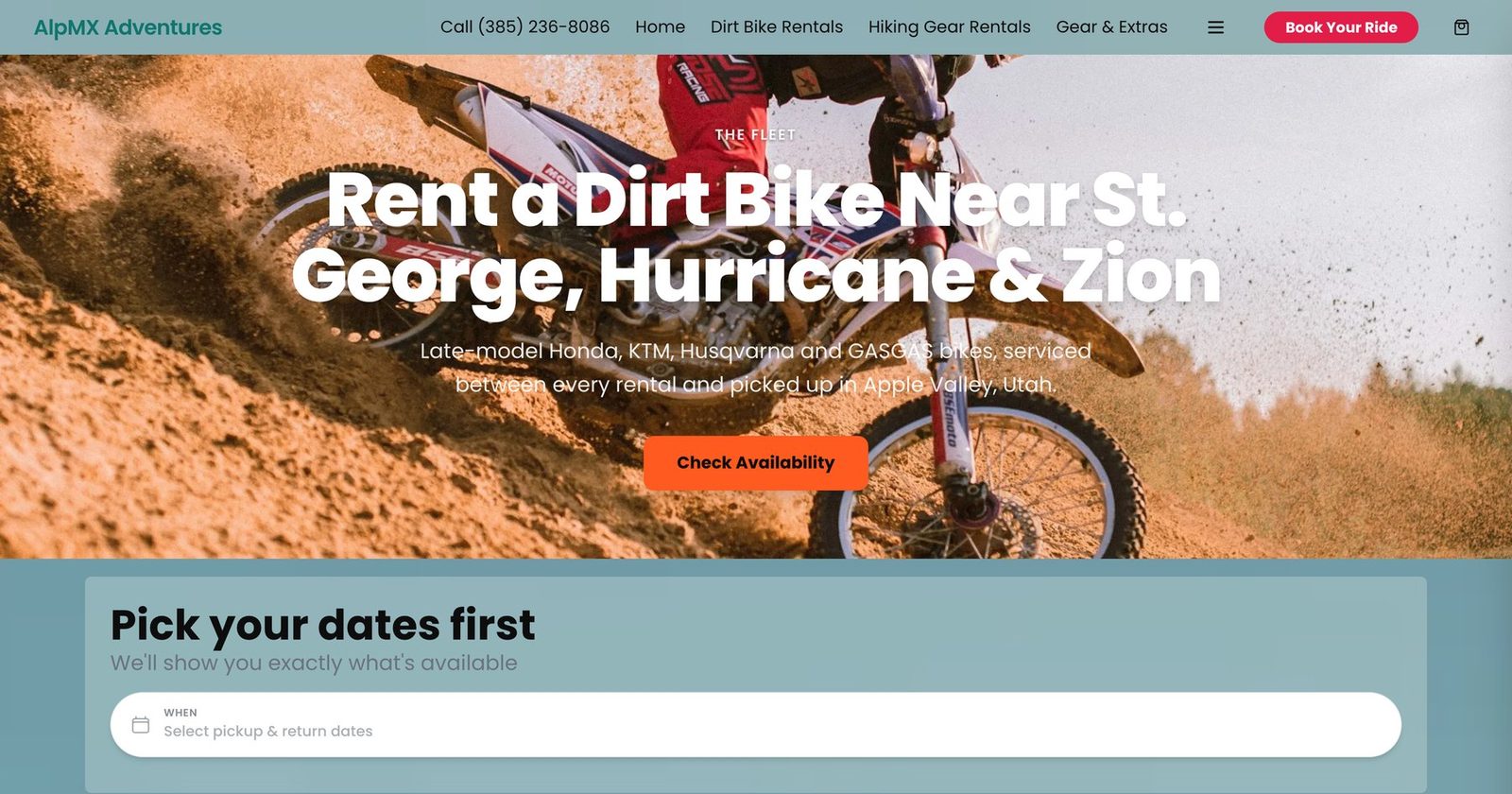
alpmxadventures.com, a live rental business site built with Renta's website builder.
Reviews and outreach
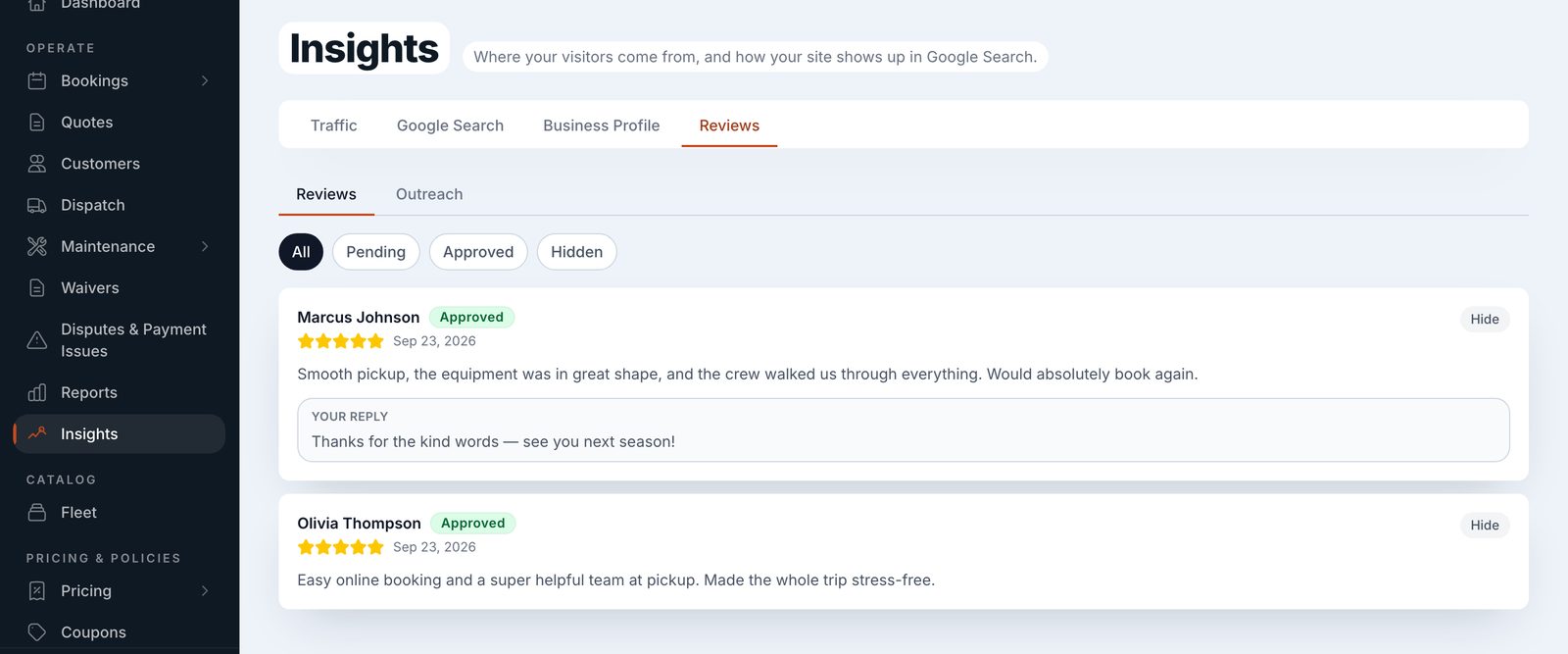
Review management and outreach, so happy riders turn into public reviews (demo account, sample data).
Frequently Asked Questions
What is the best rental software for a small rental business?
For most small rental businesses, Booqable and Renta are the strongest starting points — Booqable for general equipment, events, and bounce-house rentals thanks to its polish and ease of setup, and Renta specifically for equipment, powersports, and gear operators that want built-in maintenance tracking and marketing analytics. The right choice depends more on your niche than any single feature, so match the platform to the vertical it was actually built for.
Is Renta cheaper than Booqable?
Renta can run on commission-based pricing with no flat monthly fee required to start, which Booqable does not offer since it's subscription-only with tiers that step up as your business grows. Whether that makes Renta cheaper depends entirely on your booking volume, so it's worth running the math on your own numbers rather than assuming either pricing model wins by default.
How much does rental management software typically cost?
Flat-fee rental software generally runs from around $29/month at the entry level up to several thousand dollars a year for location-based platforms, while per-seat tools price by user instead. Commission-based platforms charge no subscription at all but take roughly 6-8% of each booking's revenue instead, so the "cheaper" option depends heavily on how much volume you actually do.
What's the difference between subscription and commission-based rental software?
Subscription (flat-fee) software charges the same amount every month no matter how many bookings you process, which becomes cheaper as you scale. Commission-based software charges nothing upfront but takes a percentage of every booking, which is easier to start with but grows more expensive as your revenue grows — this is the single biggest complaint operators raise about commission-based platforms.
Does rental software integrate with QuickBooks?
Most established rental platforms offer some level of QuickBooks or Xero integration, though the depth varies — HireHop's is considered solid, Quipli's syncs one-way into QuickBooks only, and Renta offers a direct QuickBooks Online sync. If accounting integration is a priority, test the actual sync during a trial rather than trusting the feature list alone.
Is Renta a good fit for an equipment rental business?
Yes — Renta was built specifically around equipment, powersports, and gear rental operators, with a maintenance tracker tied to real usage meters, flexible day/hourly/package pricing, and a marketing dashboard built into the same admin. It's a newer platform than incumbents like Booqable, so it has a smaller install base and fewer third-party integrations, which is worth knowing if your business already depends on a specific marketplace connection.